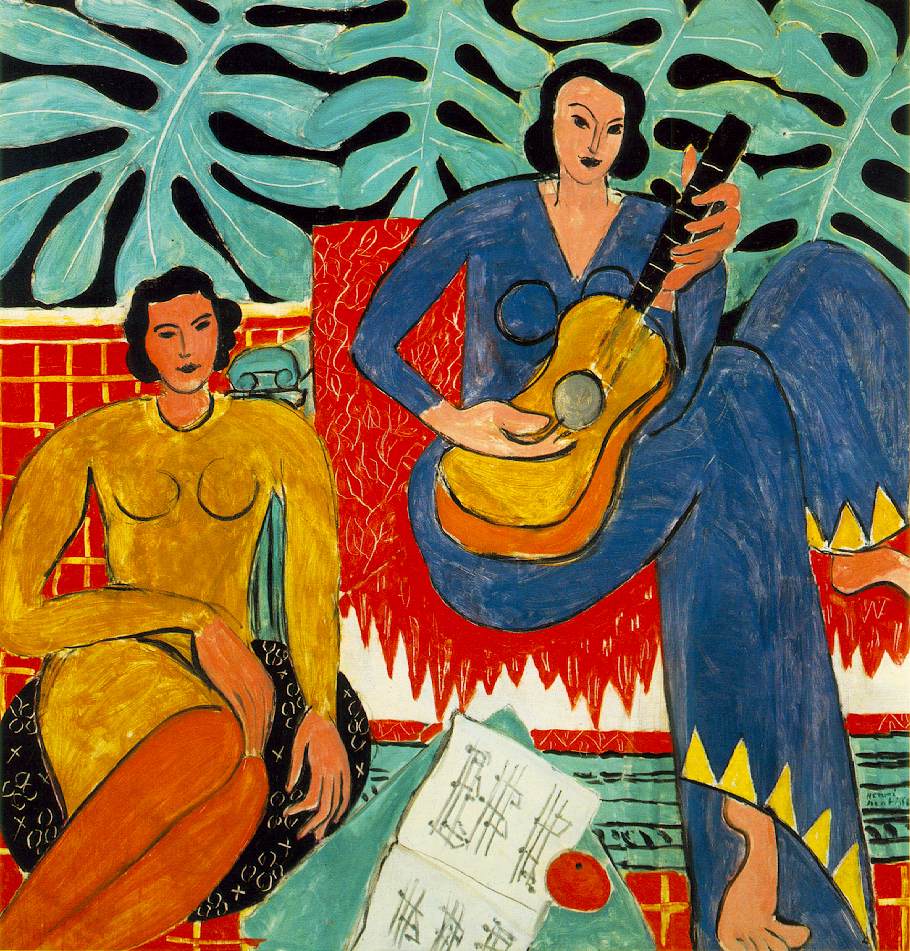
 Henri Matisse La Musique 1939 Albright-Knox Art Gallery, Buffalo, NY
Popularization of science. Categories to analyze popularization of science.
Throughout the Twentieth Century, the definition of science has changed while the perception of the role of science has transformed its place in culture. For historians of the 1940s and 1950s, science was a product of the learned elite. Science was reproduced exclusively for and within those elite, detached from the broader culture and society. Those scholars believed that science could influence social and political structures. For example, the “Scientific Revolution’s” impact on industrialization. As an attempt to incorporate lower strata in the construction of scientific knowledge, science can also be perceived as the consumption of learned products by the lower strata. However, this approach denies agency to the lower classes because they are given no role in the production of science.
Steven Shapin and Simon Shaeffer analyze science as part of the public sphere by bringing the middle-classes into science studies. They study the ways in which audiences are constructed and transformed in changing historical contexts. Science is perceived as “science as culture”, strongly related to social values, perceptions, and attitudes. Shapin and Schaeffer study the impact of science on middle-classes. They focus on how educated classes use science because of its relationships with social values, status, and morality. Bruno Latour introduces the anthropological approach to the study of science, studying behaviors and power-relationships of scientists within laboratories. Nevertheless, Latour’s approach is still elitist because the production of science belongs to learned and privileged elite. Moreover, that science has no connections to middle-class men, ordinary people, or even people outside the laboratory. There is also a historical trend that focuses on micro-histories. Micro-histories in science also pay attention to elites, such as Mario Biagioli’s study of Galileo as a courtier. Biagioli opens the game of science to the courts, the academies, and the universities. However, he extends science to women because they happen to be strong patrons.
William Eaman, Paolo Rossi, Steven Pumfrey, and Robert Darnton provide a different approach to eradicate eliticism in the studies of science. They suggest that the so called “scientific revolution” was an outcome of the interaction between the learned and the craftsmen’s knowledge. Rossi and Edgar Zilsel altered the understanding of the “Scientific Revolution.” They argue that for the first time in history, natural philosophers began to take notice of the activities of the artisan’s workshops and discovered that the methodology of craftsmen provided a model for an entirely new experimental approach to the study of nature that culminated in the philosophy of Francis Bacon. In Darnton’s attempt to analyze science popularization in the last half of the Eighteenth Century France, he argues that middle-class men used science as a vehicle for social mobility. Darnton highlights that those middle-class bourgeois appealed to ordinary people with the use of science because it was one of the main concerns and attractions of ordinary people. However, Darnton relates science to the radicalism of middle-class men in France and takes for granted ordinary people’s appeal to “science”.
Roger Cooter and Steven Pumfrey encourage the study of culture in popular culture as an alternative to science popularization. Science in culture’s goal is to understand the mechanism of how the lower strata influenced the construction of scientific ideas. Cooter, and Pumfrey suggest the main categories to study science in popular culture. Those categories are the following: mediators, audiences, diffusion of knowledge, modes of production and reproduction of knowledge and science, transmission of knowledge of science, the press, texts, museums, the impact of science on both men and women, the commercial and ideological impact of science, science as an entertainment, as social mobility, or as education, the relationship between the learned elite and its audience, the hegemonic functions of science, and the resistance of science popularization.
Department of History
Georgetown University


No comments:
Post a Comment