Saturday, March 22, 2025

Thursday, December 19, 2013

Henri Matissse Deux fillettes, fond jaune et
rouge (Two Girls in a Yellow and Red Interior) 1947 Barnes Foundation, Merion,
PA
There are two main
competing traditions that carry out popular cultural studies. Those traditions differ in the periodization of history. The Anglo-Saxon tradition roots its studies of popular culture on industrialization. Peter Burke (1978), Karin Doving (1973), Robert W. Macolmson (1971) belong to that tradition. Whereas, the French tradition’s turning point is the French Revolution. Robert Darton (1985), Michael Mullet (1987) represent the French tradition. Industrialization creates a mass production of both material and cultural objects that reach a broad, however uncertain audience. Whereas, the French Revolution distinguishes between an “Anciėn Régime” mentality and a post-revolutionary one. Therefore, the purpose of understanding popular culture depends on the periodization of history that will influence on the content, the audience, and the language of popular culture studies.
The Anglo-Saxon tradition has generally drawn a
relationship between popular culture and social class. Therefore, the
traditional definition of popular culture distinguishes between high culture
and popular culture. The former is inherent to the learned or upper classes.
Whilst, the latter represents the folklore of the lower classes, or lower
orders. The Anglo-Saxon tradition draws a distinction between high culture and
popular culture. However, scholars such as Peter Burke, Redfield, Barbu,
Fiedler, and Raymond Williams argue that popular culture studies the
relationship between the learned and the popular classes.[1]
The French tradition of popular culture does not draw a
distinction between the learned and ordinary people. On the contrary, the
purpose is to discover and understand the mentality of the majority of the
people over a long-term period of time, and a region, or culture. The French
tradition analyses values, traditions, perceptions, attitudes, symbols, tastes,
prejudices, and viewworlds shared by most of the people. The outcome of such
approach is that there are certain values, perceptions, and attitudes that
transcend both social class, and learned elite dimensions. Therefore, the French
tradition dares to talk about “mentalités” of civilizations and societies.
The Marxist and neomarxist tradition argue that popular
culture is the appropriation and transformation of the cultural creations of a
lower strata by a learned elite. They state that the learned elite of the
Enlightenment appropriated songs, ballads, sayings, plays, and stories, that
circulated among the lower strata, Moreover, this learned elite transformed the
“folklore” for both the high class and the lower strata. The purpose of
rescuing “folklore” is for the elite, related to the idea of nationhood,
aesthetics, social control, and identity. Another elite’s goal is to impart or
impose the elite’s own values, and perceptions of the world upon the lower
strata.
Popular culture analyzes the mentality of a certain
society, and civilization focusing on the shared beliefs, attitudes,
prejudices, experiences, perceptions, and traditions of the majority. The goal
of popular culture is to reject the distinction between the learned and the
lower orders. On the contrary, to analyze the shared values, traditions,
prejudices, attitudes, and perceptions or their own civilization, or society
over a long-term period of time.
By the eighteenth century, new, powerful, and robust ways of
knowing the world had been devised. The intellectual and institutional
techniques of producing and circulating universal knowledge had largely been
put in place, substantially uniting the world-wide scientific enterprise and
ensuring that scientists were, by and large, on the same page in the Book of
Nature. In the period known as the Enlightenment (circa 1720 - 1780),
practitioners continued to be occupied with questions about how such global
knowledge could be further secured and how knowledge of human beings and nature
related to political and social change. This section examines two sets of
practices characteristic of Enlightenment science, both of which had to do with
ordering and spreading new (and old) knowledge. On the one hand, the empires of
knowledge and power that Europeans had forged while travelling and conquering
the globe confronted them with nature’s teeming diversity, notably in its
living things, a diversity which created practical needs for its ordering and
classification into taxonomies. These taxonomies were subject to heated debate,
as they were attempts to understand both the nature of things and the
interrelationships between things, man, and God. We will read and discuss texts
and taxonomies from the key natural historians of the eighteenth century, the
Swede Carl Linnaeus and the Frenchman Georges-Louis Buffon. On the other hand,
practitioners also addressed knowledge about human beings as social and
economic actors, with a notable interest in the utilities of natural and
technological knowledge. They aimed to collect and arrange artisanal and trade
knowledge in encyclopedias, making this knowledge newly accessible to a
supposedly universal public sphere. We read the introduction to the
largest and most ambitious encyclopedic project of the French Enlightenment.
How do the encyclopedic and taxonomic efforts of the eighteenth century appear
in relation to practices used nowadays to capture and spread knowledge about
the diversity of the natural, social, and cultural worlds, for example, Wikipedia
replaces Encyclopedia.
[2] Braudel,
Ferdinand, Civilization and Capitalism, 15th-18th Century
[3] François-Marie
Arouet Voltaire (1694 –1778). Knowledge and Order: By the eighteenth century, new,
powerful, and robust ways of knowing the world had been devised. The
intellectual and institutional techniques of producing and circulating
universal knowledge had largely been put in place, substantially uniting the
world-wide scientific enterprise and ensuring that scientists were, by and
large, on the same page in the Book of Nature. In the period known as the
Enlightenment (circa 1720 - 1780), practitioners continued to be occupied with
questions about how such global knowledge could be further secured and how
knowledge of human beings and nature related to political and social change.
This section examines two sets of practices characteristic of Enlightenment
science, both of which had to do with ordering and spreading new (and old)
knowledge. On the one hand, the empires of knowledge and power that Europeans
had forged while travelling and conquering the globe confronted them with
nature’s teeming diversity, notably in its living things, a diversity which
created practical needs for its ordering and classification into taxonomies.
These taxonomies were subject to heated debate, as they were attempts to
understand both the nature of things and the interrelationships between things,
man, and God. We will read and discuss texts and taxonomies from the key
natural historians of the eighteenth century, the Swede Carl Linnaeus and the
Frenchman Georges-Louis Buffon. On the other hand, practitioners also addressed
knowledge about human beings as social and economic actors, with a notable
interest in the utilities of natural and technological knowledge. They aimed to
collect and arrange artisanal and trade knowledge in encyclopedias, making this
knowledge newly accessible to a supposedly universal public sphere.
We read the introduction to the largest and most ambitious encyclopedic
project of the French Enlightenment. How do the encyclopedic and taxonomic
efforts of the eighteenth century appear in relation to practices used nowadays
to capture and spread knowledge about the diversity of the natural, social, and
cultural worlds, for example, Wikipedia replaces the English Encyclopedia.
Department of History
Georgetown University
2. Popularization of Science: Its Categories
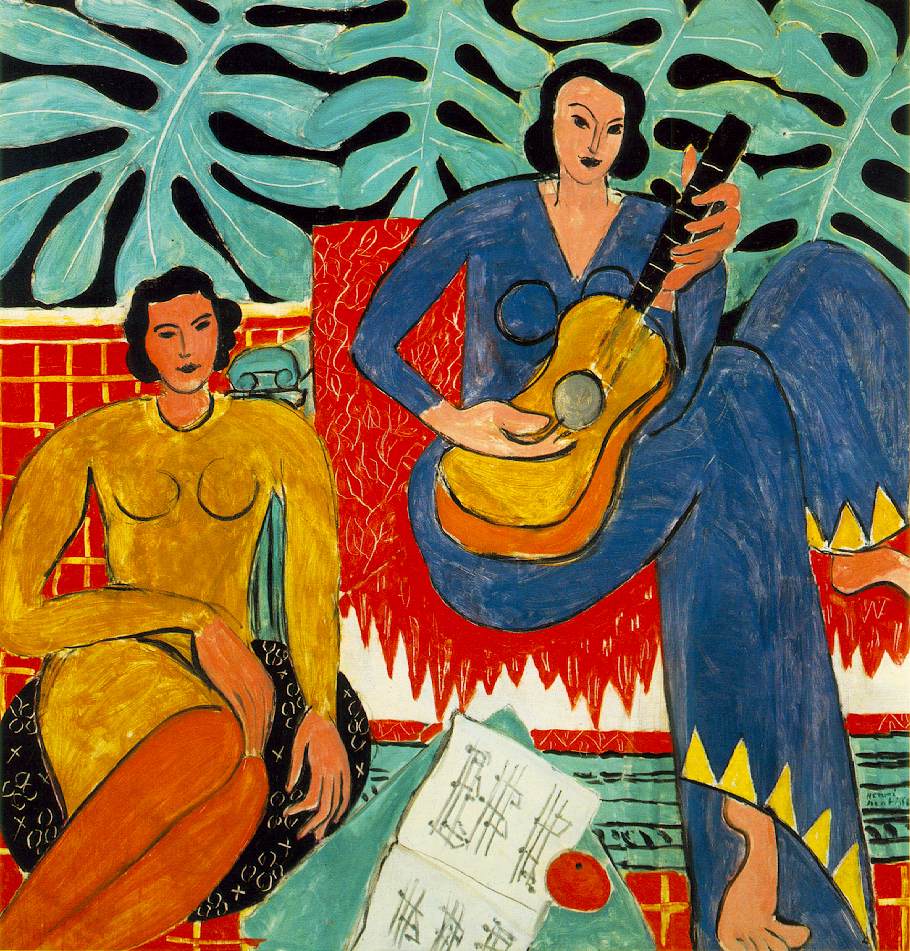
Henri Matisse La Musique 1939
Albright-Knox Art Gallery, Buffalo, NY
Popularization of science. Categories to
analyze popularization of science.
Throughout the Twentieth Century, the
definition of science has changed while the perception of the role of science
has transformed its place in culture. For historians of the 1940s and 1950s,
science was a product of the learned elite. Science was reproduced exclusively
for and within those elite, detached from the broader culture and society.
Those scholars believed that science could influence social and political
structures. For example, the “Scientific Revolution’s” impact on
industrialization. As an attempt to incorporate lower strata in the
construction of scientific knowledge, science can also be perceived as the
consumption of learned products by the lower strata. However, this approach
denies agency to the lower classes because they are given no role in the
production of science.
Steven Shapin and Simon Shaeffer analyze
science as part of the public sphere by bringing the middle-classes into
science studies. They study the ways in which audiences are constructed and
transformed in changing historical contexts. Science is perceived as “science
as culture”, strongly related to social values, perceptions, and attitudes.
Shapin and Schaeffer study the impact of science on middle-classes. They focus
on how educated classes use science because of its relationships with social
values, status, and morality. Bruno Latour introduces the anthropological
approach to the study of science, studying behaviors and power-relationships of
scientists within laboratories. Nevertheless, Latour’s approach is still
elitist because the production of science belongs to learned and privileged
elite. Moreover, that science has no connections to middle-class men, ordinary
people, or even people outside the laboratory. There is also a historical trend
that focuses on micro-histories. Micro-histories in science also pay attention
to elites, such as Mario Biagioli’s study of Galileo as a courtier. Biagioli
opens the game of science to the courts, the academies, and the universities.
However, he extends science to women because they happen to be strong patrons.
William Eaman, Paolo Rossi, Steven
Pumfrey, and Robert Darnton provide a different approach to eradicate eliticism
in the studies of science. They suggest that the so called “scientific
revolution” was an outcome of the interaction between the learned and the
craftsmen’s knowledge. Rossi and Edgar Zilsel altered the understanding of the
“Scientific Revolution.” They argue that for the first time in history, natural
philosophers began to take notice of the activities of the artisan’s workshops
and discovered that the methodology of craftsmen provided a model for an
entirely new experimental approach to the study of nature that culminated in
the philosophy of Francis Bacon. In Darnton’s attempt to analyze science
popularization in the last half of the Eighteenth Century France, he argues
that middle-class men used science as a vehicle for social mobility. Darnton
highlights that those middle-class bourgeois appealed to ordinary people with
the use of science because it was one of the main concerns and attractions of
ordinary people. However, Darnton relates science to the radicalism of
middle-class men in France and takes for granted ordinary people’s appeal to
“science”.
Roger Cooter and Steven Pumfrey encourage
the study of culture in popular culture as an alternative to science
popularization. Science in culture’s goal is to understand the mechanism of how
the lower strata influenced the construction of scientific ideas. Cooter, and
Pumfrey suggest the main categories to study science in popular culture. Those
categories are the following: mediators, audiences, diffusion of knowledge,
modes of production and reproduction of knowledge and science, transmission of
knowledge of science, the press, texts, museums, the impact of science on both
men and women, the commercial and ideological impact of science, science as an
entertainment, as social mobility, or as education, the relationship between
the learned elite and its audience, the hegemonic functions of science, and the
resistance of science popularization.
Department of History
Georgetown University
& 3. The Role
of Science in Popular Culture of the European 19th century.
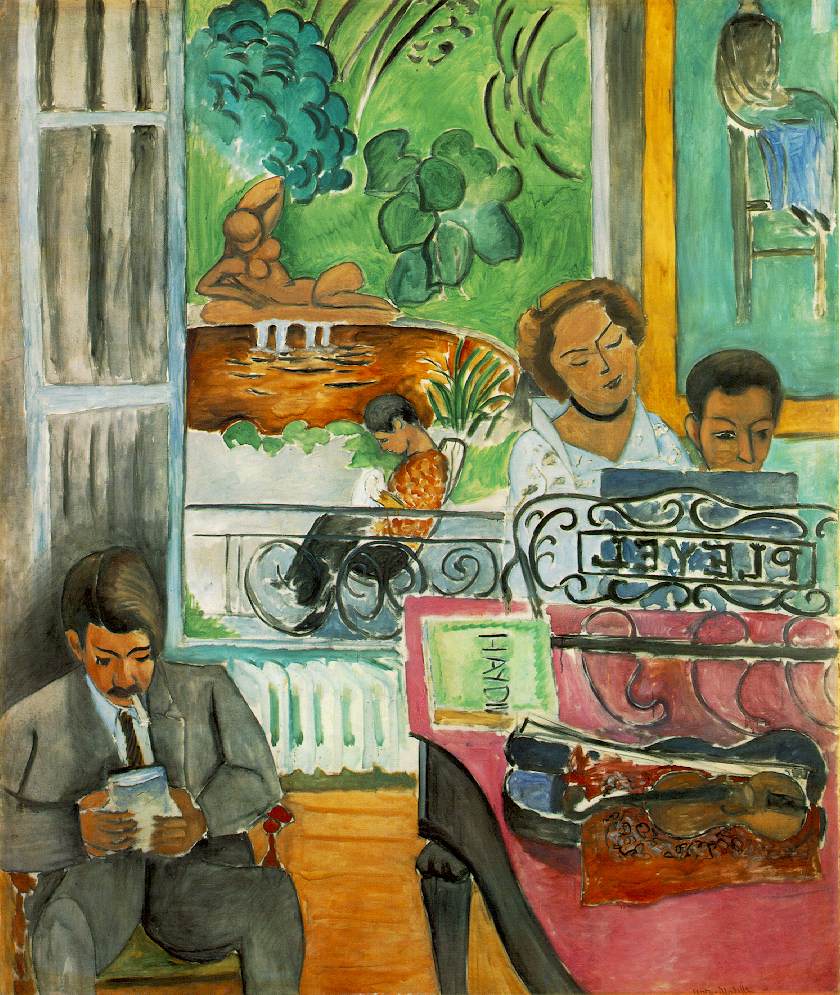 |
Henri Matisse La leçon de musique (The Music Lesson) 1917 Barnes Foundation, Merion,
The Role of Science in Popular Culture
Throughout the 20th Century, the elitist
approach of history of science shifted to the study of science in popular
culture. Elitist analysis of history of science, such as the “Scientific
Revolution”, the “Renaissance”, and the “Enlightenment”, studied the
popularization and diffusion of science among certain elite groups. Roger
Cooter and Steven Pumfrey encouraged the study of science in popular culture in
order to understand the meaning of science for ordinary people, middle-classes,
and minorities, such as women and marginal members of society. Science in
popular culture was interested in cultural resistance, struggle, and
appropriation. Robert Darnton, Paolo Rossi, Edgard Siszel, Stephen Pumfrey,
Maurice Slawinki, William Eamon, and Sarah Schechner Genuth attempted to
understand science in popular culture emphasizing the different roles that
science played in the Sixteenth Century. .
Darnton explains the role of science as a
means of both social mobility and political radicalism in the 1780s in France.
Due to the popular appeal of science in the late Eighteenth Century a group of
bourgeois supported mesmerism so as to improve their social status. These
bourgeois lacked “birth” and “title” had been rejected by the elitist
scientific institutions of France’s late Eighteenth Century despite their
wealthy and education. (Therefore, their strategy was to counterbalance their
lack of birth and connection with their education and their wealth). They
joined the “Harmonique Sociétés” that adhered to mesmerism. Mesmerism was an
alternative system to understand and explain natural phenomena, particularly
physical human being’s illnesses. This group of bourgeois moved from a medical
circle that embraced mesmerism to a political radicalism that participated
actively in the French Revolution. Their political radical emerged once they
broke up with Mesmer because these bourgeois did share Mesmer’s purposes. Mesmer
attempted to win a place within French leading scientific institutions, however
he found he could become wealthy and popular within the upper and
middle-classes. The group of bourgeois’s purpose was political rather than
social and economic. Thus, the “Harmonique Sociétés” achieved political and
social relevance in France’s “campagne”, particularly in the south-east of
France, from Strasbourg, Lyon, Grenoble, Nîmes to Montpellier. Darnton argued
that the political radicalism based on the “scientific idea” of mesmerism was
an alternative and competing system of understanding the world to the
“Enlightenment ideas” spread by elitist proponents, such as Marie Jean Antoine
Nicolas de Carit Condorcet, Francois Marie Arouet Voltaire, Jean Jacques
Rousseau, and Jean Le Rond D’Alambert. Mesmerism’s revolutionary message was to
reform institutions by physically regenerating Frenchmen. According to
mesmerism, the improvement of bodies would elevate the morality of the
Frenchmen, and better morals would produce political effects. The elite’s ideas
of “Enlightenment” were rooted on the relationship between physical-moral
causality which from Darnton’s point of view would keep the status-quo rather
than lead to social and economic change.
Rossi, Pumfrey, Slawinki and Zilsel
altered the understanding of the Scientific Revolution. For the first time in
history, natural philosophers began to take notice of the activities of the
artisan’s workshops, and the methodology of craftsmen provided a model for an
entirely new experimental approach to the study of nature that culminated in
the philosophy of Francis Bacon. They argued that there were changes in the
institution, the role, and the social need of “scientists”.[1] Rossi and Zilsel
demonstrated how the scientific activity shifted from universities to princely
courts, formal urban academies, and organized scientific societies in the
Sixteenth Century. Scientist became courtiers that had to meet the needs and
whims of their patron. These authors analyzed were authority lied in the
Sixteenth Century and the arguments to legitimate scientific endeavors.
William Eamon embraces Rossi and Zilsel’s
argument of how craftsmen were active actors in the construction of scientific
knowledge. Eamon argued that the relationship between natural philosophers and
craftsmen led to the Baconian method. Eamon also argued that the scientific
elite denied the craftsmen’s contribution to their new physical understanding
of natural phenomena. They did not want to make explicit that they were engaged
in “pseudoscientific” activities and denied that they had appropriated
craftsmen’s traditional knowledge. Eamon argued that both the empiricism and
experience of the Baconian method have their origins in craftsmen’s traditional
way of solving problems. The “Book of Secrets” illustrated how widespread
empiricism and experience were among craftsmen. The “Book of Secrets” have
nothing to do with magic, the supernatural, or occultism; on the contrary, it
is the emergence of a new genre based on a set of “recipes” that tell ordinary
people how to solve everyday problems of the Sixteenth Century. The “Book of
Secrets” was written by the urban intelligentsia of diverse social status. The
intention of the authors was to acquire fame, and to advertise their recipes as
a means of redefining their social status by using science and noble features.
They did not confront the social or political organization of the Sixteenth Century.
Therefore, their range of interests was limited, restricted to those arts which
did not come into conflict with aristocratic sensibilities. Because of this,
mechanical arts were not among their interests. Their attitude towards arts was
that one of “virtuosity”. Their ultimate goal was to construct a new model of
nobility that was more appropriate to urban classes that lacked both birth and
title, while possessing wealth and education. Therefore, the urban
intelligentsia aspired to redefine the urban nobility in terms of virtue and
personal merit. The “Book of Secrets” illustrated how widespread and appealing
empiricism and experience were among ordinary people. And the bourgeois people
capitalized on their large audience in order to elevate their social status. At
the very end, the authors did not want to overthrow the social, political, and
economic structure of the Sixteenth Century. They merely pursued to find their
role within the urban learned elites of the Italian cities of the Sixteenth Century.
.
Schechner Genuth argued that ancient
folklore, religious ideas, magic and popular beliefs influenced the learned
elite’s development of cosmology. She challenges the traditional explanation
that Newton and Halley swept away the superstitious beliefs of comets in two
ways. First, she argued that neither scientific theories nor philosophical
debates were sufficient to dispel the widespread belief in commentary
divination. Second, she showed that natural philosophers – such as Newton -
retained something of the traditional lore because they never linked comets
with changes in the state or the church. The “Scientific Revolution’s” ideas
were conservative because they did not challenge the social or political order
but rather reinforced important values, behaviors, and beliefs of those
structures. Schechner Genuth analyses the meaning of comets in the Seventeenth
Century. The roots of those beliefs lied in ancient folklore, which had been
appropriated by both early Christians that interpreted folklore as signs of
God’s wrath, and the “Reformation.” She explores the interplay between the
superstitious dread of comets shared throughout the ages by peoples at all
levels of society, and the role of comets in the birth of cosmology. She also
highlighted the contradictory meaning of comets in the Seventeenth Century,
while Newton gave comets a benign purpose; ordinary people acknowledged the
catastrophic consequences to be expected if a comet were to collide with the
earth. Nineteenth and Twentieth Century ideas about comets conformed to the
naturalistic and uniformitarian principles that governed geology. Meanwhile,
popular comet lore retained its own power that was shown by the fear,
uncertainty, and vulnerability that learned and non-learned people shared
towards the effects of Halley’s Comet in 1910. Schechner Genuth carries on an
excellent and knowledgeable historical study of cultural responses to comets
from the Antiquity to the present.
Department of History
Georgetown University
[1] The use of
scientist for the eighteenth is an anachronysm that Rossi and Silzel should pay
attention to by redefining his concept of scientist.
& 4. How does popular science
play a role in gender construction?
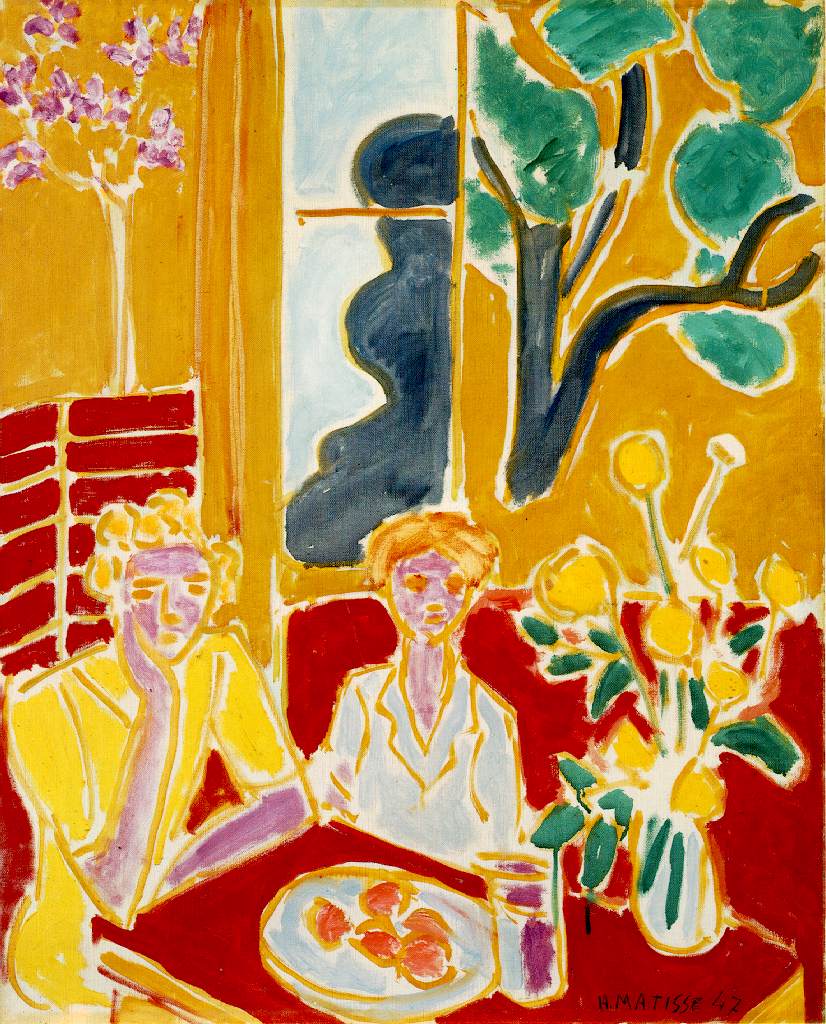 |
Henri Matissse Deux fillettes, fond
jaune et rouge (Two Girls in a Yellow and Red Interior) 1947 Barnes
Foundation, Merion, PA
Londa Schlesinger’s “Nature’s Body” and
Cynthia Russet Eagle’s “Sexual Science and the Construction of Victorian
Womanhood” are two welcome books that show how both scientific ideas and race
constructed a particular idea of womanhood in the nineteenth century. Most of
the scientific ideas they analyze do not root on empirical data, but rather
than on popular beliefs of what a woman should be. Those popular beliefs are
part of popular science. The “scientification” of popular beliefs leads to a
“naturalization” of gender. Londa Schiebinger makes an excellent use of the
categories of gender and race to analyze a serious of scientific ideas of the
nineteenth century. Schiebinger emphasis the importance of the joint study of
gender and race because the scientific ideas she analysis aim to show the
inferiority of women over men. Schiebinger asserts that the naturalization of
gender imposes the construction of gender due to nature rather than to
nurture as John Stuart Mill. Thus, women are inferior to men due to nature.
John Stuart Mill’s idea of the construction of gender due to nurture gets
lost. Eventually, Schiebinger argues that the construction of gender was
based on biased “scientific observations’ that were rooted on the chauvinist
idea of the inferiority women upon men. These popular beliefs are defined as
social and popular beliefs of gender. Russet Eagle argues that a large number
of scientific ideas of the Victorian era were based on popular beliefs of the
idea of woman and men rather than on empirical data. She asserts that problem
was that the “scientific’ “data that those scientists had was interpreted
through the lenses of popular beliefs and prejudices. Moreover, Russet Eagle
adds an interesting distinction depending on professions. She demonstrates
that scientists were had a tendency to emphasize the inferiority of women and
the importance of the private activities. Meanwhile, lawyers, writers, and
others did not make such a strong distinction between men and women. What is
more, the latter supported the suffragist movement of American and Great
Britain. The nineteenth century’s scientists were obsessed in studying the
differences between women and men in a large variety of both social and
scientific disciplines. The bias of most of nineteenth century scientists was
to take for granted their misogynistic arguments about gender differences. They
transformed their popular beliefs into empirical data. Therefore, their
construction of gender was rooted mostly on popular beliefs rather than on
empirical data and observations. Through an examination of Darwinism,
Darwinism, race, anatomy, physical anthropology, and physics it becomes clear
that the construction of gender has been historically been influenced more by
popular beliefs than by empirical data.
Darwin’s evolutionary theory
demonstrated how in the evolution from apes to men, women were the link
between the two. His evolutionary theory postulated the inferiority of men
based on brain faculties, such as intelligence and smartness.
Department of History
Georgetown University
@4. How does popular science play in gender construction
Henri Matisse Flowers in a
Pitcher 1906 Barnes Foundation Merion PA
Russet Eagle argues
that a large number of scientific ideas of the Victorian era were based on
popular beliefs of the idea of woman and men rather than on empirical data.
She asserts that the problem was that the “scientific’ “data that those
scientists had was interpreted through the lenses of popular beliefs and
prejudices. Moreover, Russet Eagle adds an interesting distinction depending
on professions. She demonstrates that scientists had a tendency to emphasize
the inferiority of women and the importance of the private activities.
Meanwhile, lawyers, writers, and others did not make such a strong
distinction between men and women. What is more, the latter supported the
suffragist movement of America and Great Britain. The
nineteenth century’s scientists were obsessed in studying the differences
between women and men in a large variety of both social and scientific
disciplines. The bias of most of nineteenth century scientists was to take
for granted their misogynistic arguments about gender differences. They
transformed their popular beliefs into empirical data. Therefore, their construction
of gender was rooted mostly in popular beliefs rather than on empirical data
and observations. Through an examination of Darwinism, Darwinism, race,
anatomy, physical anthropology, and physics it becomes clear that the
construction of gender has been historically influenced more by popular
beliefs than by empirical data.
Darwin’s evolutionary theory demonstrated how in the evolution from apes to men, women were the link between the two. His evolutionary theory postulated the inferiority of men based on brain faculties, such as intelligence and cleverness
@ Londa Schieinger analyzes if mind have sex?
Londa Schiebinger
places a difficult and simple question in an excellent fashion: why is there
such a huge absence of women in the history of modern Western scientific
culture? Schiebinger argues that a male-dominated society deterred women from
becoming visible and active practitioners of the scientific enterprise[1]. Schiebinger asserts that social and historical constructions
of the female and of the notion of femininity give way to the predominant
idea of the nineteenth century: women have to take care of children, the
household and the private affairs. Schiebinger analyzes four main topics:
educational and scientific institutions, biographies of female scientists,
traditions in female craft and labor and the social construction of the ideas
of female and femininity. I address women's participation in the scientific
debates that have shaped our definitions society and of the human.
Schiebinger examines
femininity and exclusion. She follows women from their utter exclusion from
monasteries and universities of medieval Europe to their placement
on the periphery of scientific academies. In the seventeenth centuries, women
were full participants of scientific conversations and at the end of the
eighteenth century women were ousted to the periphery of science. Slowly
women were ousted to the periphery of science at the end of the 18th century
and they became mere practitioners or technicians[2]. Schiebinger illustrates that women had more opportunities of
participating in science during the seventeenth and eighteenth centuries than
in the future centuries. The French and English science academies forbade
women to become members of those institutions, for instance, Margaret
Cavendish (1623-1673) never made it into the Royal Society despite the fact that, she
continued her contributions to advance to the scientific enterprise. However,
women of rank and gave patronage put them in a higher position on contrast to
humanists – who were considered of less rank rather than royal women and even
of other nobles with had lesser rank than hers. Women of rank and patronage
had a place at the conversational table as full participants. Therefore, the
relationship between the scientific client and the woman-patron made many
male scientists to think that natural philosophy needed women. Leibnitz
writes to his patron and colleague, Queen Sophia Charlotte of Hanover (1668
–1705) “women of elevated mind advance
knowledge more properly than do men.”. Salons of the eighteenth century
become the most important social spaces for women to talk and learn about
science, nevertheless, women’s opinions were limited, women voiced ideas but
men developed and carried out and experimented ideas.
Shiebinger’s compendium of biographies of woman in science leads to two broad
generalizations. In France and in England, rank and patronage
enhanced women to participate in science. A matter of fact, their families
had both the means and the willingness to provide education to their
daughters. Schiebinger shows that the German case differs to the French and
the English. In Germany, experimental science honored the work of
craftswomen. For example, the astronomer Maria Winkelmann (1670– 1720) worked alongside her husband - as full
participant, even though that work did not provide her with membership in
the Berlin Academy.[3] Maria was an example who carved her natural philosopher
professional/identity from the end of the seventh to the beginning of the
eighteenth centuries. She was a natural philosopher who had had a business,
later joined the university staff of and at the end of his life she accepted
patronage. As married, his husband and she founded a business, they practiced
natural philosophy with their own money. As married with his husband, they
had owned a business. After his husband passed of, he joined a university
staff. At the end, she quit the university and accepted patronage. She chose
patronage because it was more prestigious than being a university professor.
As a courtier she was independence and earned more money than she did at her
two previous jobs.
Maria was educated by her father - a Lutheran minister. He believed young boys and
girls should be imported equal education. After the death of this
father, her uncle continued hers studies. Her passion was astronomy. She had
the chance of studying natural philosophy with Christoph
Arnold (1650-1695)[4]. He was a self-taught astronomer who
worked as a farmer in Sommerfeld, near Leipzig. Maria turned into his
unofficial apprentice and later her assistant. Through Arnold, Maria met
the astronomer and mathematician Gottfried
Kirch, one of the most famous German astronomers of the time. Kirch and
Maria married in 1692. Gottfried Kirch taugh astronomy to Maria – his wife –
and his sister. He had students. Women were forbidden to attend university
therefore Gottfried conducted its courses outside the universities cloisters.
Despite the fact that Maria and Gottfried worked as a team, it was seen that
Maria was his husband’s assistant rather than an equal. In1697, the couple
also began recording weather information. Weather data was needed to produce
calendars and almanacs for navigation, among others. The Royal Academy of Sciences in Berlin bought
their calendars with which the academicians could prescribe the phases of the
moon, the setting of the sun, eclipses, the position of the sun and other
planets. She was the first woman to discover a comet. After regular nighttime
observation, Maria discovered a previously unknown comet, the so-called
"Comet
of 1702" in 1702.
Gottfried died in Berlin on 25 July 1710. Onwards, the Royal
Academy of Sciences rejected buying the calendars and almanacs of her
husband’s business. At that time, the president of the Academy was Gottfried Wilhelm Leibniz. He knew
María’ research and he had encouraged her. As a widower, she besought the
Academy for help. Leibniz was the only member that supported Maria’s request.
In 1709, the royal court of Prussia invited her as courtier. Nevertheless,
first Maria had to discuss about sunspots with the Prussian natural
philosophers of the court. She got a good impression and joined as a courtier
to the Royal court of Prussia. In 1711, Maria published Die
Vorbereitung zug grossen Opposition which predicted a new comet. In
1712, Maria accepted the patronage of a family friend, Bernhard Friedrich Baron
von Krosigk - an amateur astronomer. Maria had an observatory, trained her
son and daughters, became her assistants and continued the family’s
astronomical work. They followed the family trade: producing calendars and
almanacs, and making observations. Baron von Krosigk died in 1714. Maria
assisted for a professor of mathematics for two years. Peter the Great
offered her to join Russian tsar court in 1706. Nevertheless, she preferred
to stay in Berlin and continue observing data at several places,
such as Nuremberg, Dresden, Breslau and Hungary.
Arnold, Christoph (1650-1695) was born in Sommerfeld
near Leipzig. His father was a farmer who was interested in astronomy. Arnold discovered
the great Comet of 1683.
Maria's son - Christfried Kirch - became director of
Berlin Observatory of the Royal Academy of Sciences in 1716. He
replaced Johann
Heinrich Hoffmann (1669-1716) after
his death. Maria and her daughter - Christine - became his assistants.
Academy members disagreed with Maria behaving as an informal director rather
than an assistant. She was forced to retire. Maria continued working in
a private capacity at home but there was no observatory at her house. She
died in Berlin in1720. Her three daughters continued her mother’s
work, and after her death, they assisted to their brother as master
astronomer at the Berlin Observatory of the Royal Academy of Sciences.
Shiebinger unaddressed why she accepted to work without
recognition? She wonders how Maria was perceived by male astronomers and
female astronomers too. Did academicians considered improper and impossible
María becoming a member of the Berlin Academy? These biographies
show how many women were interested in science[5]. Therefore, Schiebinger recovers lost women that participated
in science before astronomy became a profession.
The unstable and recognized position of women in science changes dramatically
at the end of the eighteenth century; nature appears as female but/and
science as male. The idea that science had masculine features is reinforced
and, at the nineteenth century, the masculinity of science was established.
Schiebinger argues that the social construction of the image of women as
feminine is emphasized particularly by physicians. Philosophers and
physicians would assert that the mind has sex, females think in a different fashion
from men due to their sexual differences. Those thinkers end up saying that
women’s intellect is not suited for scientific research. Schiebinger
shows how physicians sexualize the skeleton, something new in comparison to
early modern anatomists Now the female studies as a sexualization of the
object of scientific study. Now female studies sexualize its body as an
object of scientific research. By the mid-eighteenth century, the
representation of females often deliberately exaggerated the size of the
pervix and diminished that of the head and ribcage in order to fit emerging
ideas of masculinity and femininity. The conclusion was that women and men
had complementary roles and men are the ones suited to carry on science. The
construction of the female image was that women were sexed, had a subhuman
mind and suffered from sexual lust. The notion of feminine was featured by
mental and physical frailty and was incompatible with masculine science.
[1] Schiebinger,
Londa, The Mind Has No Sex? Women in the Origins of Modern Science (Cambridge:
Harvard University Press, 1989)
[2] Suzuki, Mihoko ed., History of
British Women's Writing, 1610-1690, Vol. III (London: Palgrave
Macmillan, 2011Schiebinger,
Londa, “Maria Winkelmann at the Berlin Academy : A Turning Point for Women in
Science: , Isis Vol. 78, issue 292,
1987, Berlin: Springer-Verlag), 174–200. Maria Winkelmann married Gottfried Kirch
- Kirkius Kirche (1639-1710) in latin - in
1962 in Guben. website http://www.sheisanastronomer.org/index.php/history/maria-winkelmann-kirch. "Maria Winkelmann Kirch." Welcome
to "She Is an Astronomer" 2010. Web. 03 Oct. 2010. http://www.springerreference.com/docs/html/chapterdbid/58775.html, Kirch was an observer. He was chosen
permanently astronomo ordinario at Berlin on
in 1700. His father – Michael Kirch - was a tailor but did not follow his
fathers craft. Erhard Weigel was a natural philosopher and hold a chair at
the University of Jena. Kirch was Weigel’s disciple despite he
was not a university student. Website, http://www.springerreference.com/docs/navigation.do?m=The+Biographical+Encyclopedia+of+Astronomers+(Physics+and+Astronomy)-book59, The Biographical Encyclopedia of
Astronomers.
[4] Website, http://www.plicht.de/chris/a01.htm#Arnold, Arnold,
Christoph (1650-1695) was born in Sommerfeld near Leipzig. His
father was a farmer who was interested in astronomy.
Department of History
GeorgetownUniversity
5.
Problems in the definition of public sphere: Juerguen Habermas’s
definition of public sphere
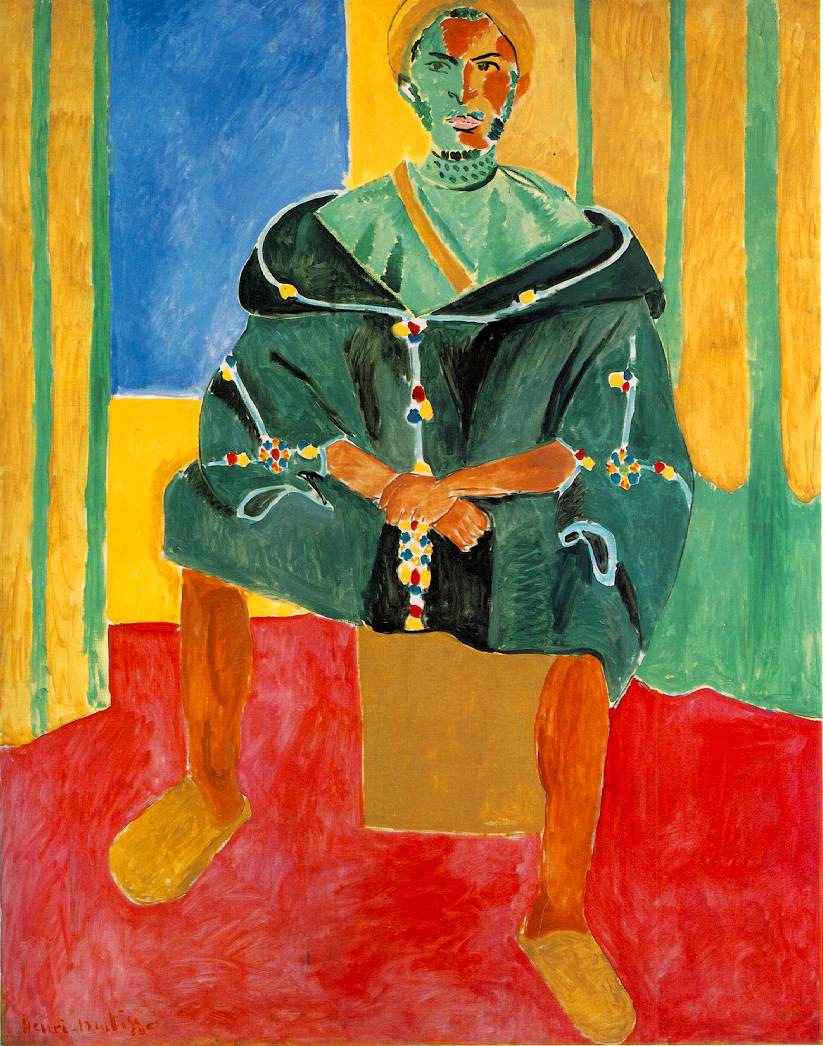
Henri Matisse Le Rifain assis (Seated
Riffian)
Late 1912 or early 1913 Barnes
Foundation, Merion, PA
Jürgen
Habermas argues that the definition of public sphere is a social and
historical concept that changes its form depending on the economic, political,
and social structure it belongs to. The public sphere is part of civil
society defined as realm of commodity exchange and social labor governed by
its laws. Habermas’s main concern is to define the bourgeois public sphere
that emerges in the eighteenth century in Europe.
The bourgeois public sphere is the coming together of private persons as a
public to discuss political issues. Habermas asserts that the bourgeois
public sphere is entirely detached from the state because their power lies on
the market rather than on politics. The independence of the bourgeois public
sphere relies on a commercial capitalist economy that emancipates them from
political power, state rules and the law. This economic independence leads
them to challenge the laws of the state throughout a rational-critical polite
discourse. Salons and literary societies are the new institutions of the
bourgeois public sphere where the bourgeois discusses and challenges the old
economic and political order. Habermas contends that the bourgeois society of
the eighteenth century undermines its old rulers and takes them over by means
of the market and the use of reason. Habermas agrees with Marx and Hegel that
the emerging bourgeoisie is conscious of the political role of the public
sphere as an ideology to impose their own interest to the whole people. The
bourgeoisie will impose their own laws throughout a rational-critical debate,
such as the enforcement of property rights and family structure. Eventually,
Habermas asserts that the public sphere is the organizational principle of
the bourgeoisie.
Habermas studies the changes of the public sphere as a part of civil society over time. He traces the public sphere’s changes following economic, linguistic, and political criteria. He particularly emphasizes the capitalist system and the linguistic use of the categories of both private and public. Habermas’s different forms of public sphere root in the early, conservative capitalist system, mercantilism, commercial capitalism, liberal capitalism, and monopolized capitalism. Habermas’s analysis of the relationship between public and private lead him to conceptualize the different forms of public sphere and allows him to define the bourgeois public sphere of the eighteenth century. The classical conception of public is embedded in the polis. At the same time, the oikos or the household was private. The Middle Ages is a puzzling historical period in which the Roman Law was quite detached of what actually happened either in fiefs of manorial lands. The public sphere’s name is “res publica”. The most important feature of feudalism was the lack of distinction between public and private. The modern state allows the emergence of a public sphere detached from the state. The modern state conceives the conformation of a bourgeois public sphere whose aim is to impose its own interests by means of universal laws. Therefore, the bourgeois needs to convince the political structure to make such changes as if they were for the sake of the people rather than for the bourgeois social class’ interests. Habermas studies the decomposition of the bourgeois public sphere at the end of the nineteenth century along with the emergence of a monopolistic capitalism. This new fashion of capitalism gives importance to global companies and leaves aside individual profit-makers. Hence, the political function of the bourgeois public sphere fades away and becomes insignificant. Its social composition changes, the old eighteenth century bourgeois society recognizes and strengthens its ties with the state. Hence, the political function of the public sphere transforms Ginto publicity, consumption, and marketing. The way he characterizes the definition of bourgeois public sphere is problematic. Two problems arise from his definition. First, Habermas’s accurate definition of bourgeois public sphere is astounding. How can a historical category become so defined and constant? His definition of bourgeois public sphere detaches politics from economics. He assumes that the commercial capitalist system influences the political structures. However, his transition from economics to politics is as sophisticates so as to use the bourgeois public sphere as a link between both. The problem is that his definition of bourgeois public sphere perpetuates the detachment between economics and politics. He argues that the bourgeois public sphere is detached from politics. However, Habermas takes for granted by what means did the bourgeoisie achieve its economic wealth How could that bourgeoisie emerge without a weakness of the ruling political and economic structures. Habermas argues that the capitalist system is determining the political and the structures of the eighteenth century. Second, Habermas gives a short account of the exclusion of women from the bourgeois public sphere. However, he does not focus on the consequences of their exclusion on the formation of a new public sphere, political structure, and capitalist dynamic. Despite his acknowledging that the bourgeois public sphere was ideological, he does not relate the bourgeois ideology with the rational-polite discourse. Why is the bourgeois public sphere important for studying the popularization of science? Science becomes one of the most fashionable and appealing issues within the bourgeois public sphere. One of the main concerns of the eighteenth and, particularly, the nineteenth century is the importance of science upon daily life and the capitalist system. Science becomes an increasingly important topic to leave aside from the bourgeois public sphere. The problem is that the bourgeois mentality influences scientific conception and data. The ideas of the bourgeois public sphere permeate thke data of scientific ideas. Prejudices and biases about gender and public/private affairs will be borrowed as scientific data. The discourses and its variety of forms in salons impose social and historical distinctions between the following opposites: public/ private, and female/male. The problem is that the bourgeois public sphere takes for granted as natural both oppositions. The bourgeoisie denies the social and historical constructions of both oppositions. Thus, the bourgeois public sphere gives predominance of male upon females. Consequently, male activities, duties, public affairs and even opinions become increasingly important. The male behavior and discourse is predominant upon females. The main distinction is that females take care of the private sphere, particularly the bourgeois family structure while men address public affairs. This division of labor is based on the belief system that public activities are more relevant than private ones. Therefore, the bourgeois public sphere emphasizes the gender difference in a way that females are inferior to men. Women are excluded from public realms, mainly from science. Therefore, women who want to become members of the scientific enterprise will do it by paying a high price. They are the invisible and non-recognized aids of scientists. Why is the concept of bourgeois public sphere important for studying the role of science in popular science? The emergence of a bourgeois public sphere emphasizes the difference between social classes and its roles and functions within society. One of the main concerns of the bourgeoisie is to distinguish themselves from the working-classes, Thus science becomes a way of distinguishing from the working-classes. The bourgeoisie looks down on the working-classes. The bourgeoisie has to make clear that they own the means of production whereas the proletariat does not. The proletariat is transformed into an object that works for its weekly-wage. Marx and critics of the overtaking of a capitalism system that did not care for social problems, highlight the alienation of the worker under the capitalist system at the end of the nineteenth century. The class distinction leads to a cultural distinction; the science of the bourgeoisie and that of the proletariat. Science is a very important cultural distinction that will increase the gap between the bourgeoisie and the working-classes. The role of science in popular culture looses importance and becomes looked upon before the “scientific” discoveries that lead to progress and the development of society. The role of popular science looses ifs capacity of social mobility, political change, and influencing upon the scientific mainstreams ideas. Department of History
Georgetown University
|
@6. The Example of the Chemistry
Community and the Construction of the Public Sphere
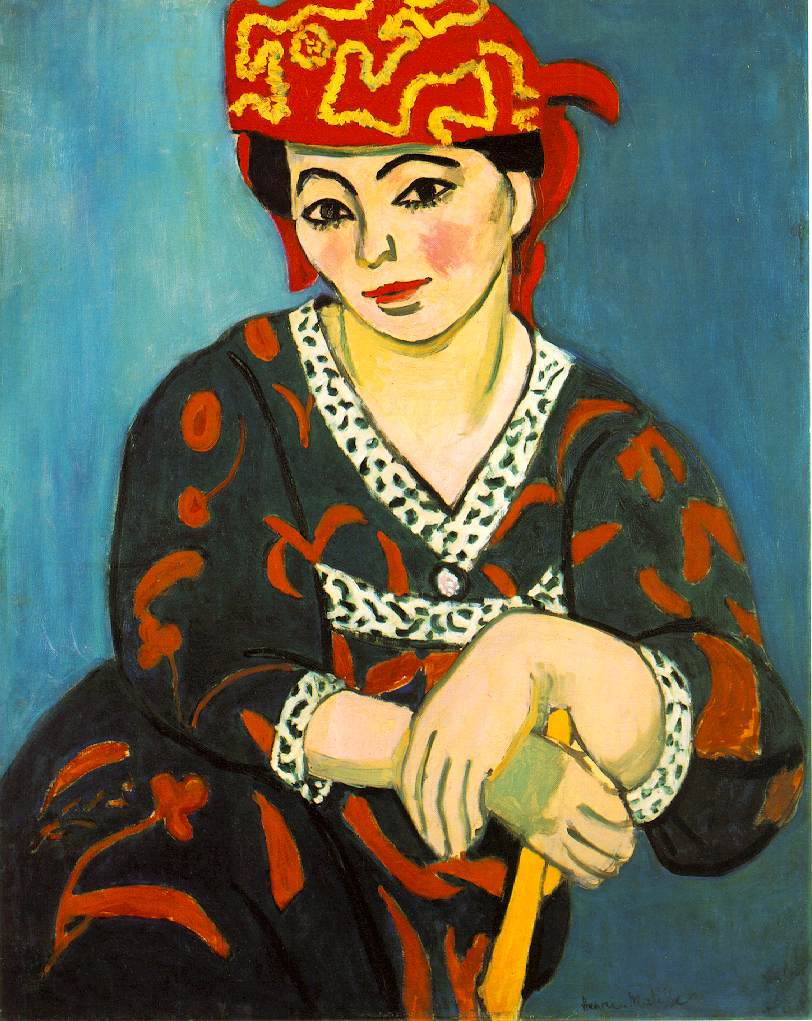
Henri Matisse Robe violette et Anemones
1937 Cone Collection, Baltimore Museum of Art
Taking Jan Golinski’s work as the primary example, explain what this group of historians means when it refers to “science as public culture”. He pays particular attention to how this group of historians defines the public.
This paper explores the relationship between the development of science in the Eighteenth Century and its audience. Sociological approaches to the history of science emphasize the fact that local contexts and history define the outcome of the cognitive content of certain scientific disciplines. Golinski’s analysis the social shaping of chemistry is an excellent starting point to study how social values, behaviors, education, and social status of the audience shaped other disciplines in the eighteenth century. The following paragraphs explore who was the audience or the public culture of the divining rod, and women’s popular science writing in England.
Jan Golinski argues that particular communities that supported British chemists shaped the ways research was conducted and findings were presented. Moreover, Golinski demonstrates the differences between the Scottish and the British communities that supported chemistry. In Scotland, chemists were accepted because of the importance ofchemistry to technology and regional identity. In Britain, chemists won their acceptance by supporting a political, social, and economic order of the Eighteenth Century. Eventually, Golinski asserts that social values, political and social concerns of the audiences shaped chemistry’s cognitive content. Moreover, Golinski illustrates how science adjusted to the shifting composition and value-system of its audience. As the audiences changed their social components, the discourse and the cognitive content of chemistry shifted to conform to the new audiences.
Golinski uses the sophisticated term of public culture to refer
to his audience. His definition of public culture is rooted in Jürgen
Habermas’s definition of the “public culture” as an arena for political
discourse that is not under immediate control of the state. The existence of
public culture allows redefinitions of political, economic, and social values
and behaviors within a historical and regional context so as to gradually
reform or abruptly change its status quo. Joseph Priestly embodies the active
civic role for chemistry, a moral dimension to the science and the democratic
diffusion of socially useful research by egalitarian cadres of practitioners.
However, the public culture that supported the chemistry community shifted from
having an active role related to political reform in the 1790s to a passive one
motivated by economic interests in the 1810s. In the 1810s, the public
chemistry deployed the discoveries of great men to a more passive audience in
ways that underscored social, political, and theological conservatism. The main
institution was the Royal Academy and its main practitioner was Humphry
Davy. The new passive audience founded Davy’s chemical scientific pursuits by
becoming his patrons because his chemistry did not threaten the social,
political, and economic order of the 1810s.
Michael Lynn studies the changing public culture that supported
the legitimacy and social recognition of the divining rod during the
Enlightenment in France. In the
1690s, the diving rod’s practical use was to find minerals or water, as well
as, criminals, especially murderers. In the Seventeenth Century the divining
rod’s practice attracted a large audience. Theologians, doctors, physicians,
natural philosophers and even astrologers had their own opinion about the
cultural meaning and the utility of the divining rod. Later in the 1770s and
the 1780s, the divining rod captured the imagination of the French again but
from a more conservative perspective. The battle over the divining rod focused
on where authority lay. The education and social status of the witness
determined the validity of the divining rod.
Ann B. Shteir argues that the audience for women’s popular
science writing in England was children. Shteir focuses on Maria
Jackson’s writings on popular science. Shteir demonstrates that women
cultivated a market for popular botanic books from the 1790 to the 1840. Maria
Jackson had scientific interests but she had to leave them aside to conform to
the social rules of British society in the Nineteenth Century. Jackson discovered that popular botanic
book-writing was one of the few ways women could participate in scientific
discourse. However, it was bounded by the literary conventions of social and
political restraints. That is to say, the role of women in science writing was
restricted. So was her audience. Jackson was expected to write mainly for
children, and she thus fulfilled the expectations of her society.
The chemistry community in Britain and Scotland, the divining rod in France, and women’s popular science writing in England, were shaped by the value-systems of their audiences. Jan Golinski, Michael Lynn, and Ann B. Shteir’s purpose is to illustrate the historicity of the audiences. The audiences of the Enlightenment period were critical and were engaged in social, political, and economic reform. Therefore, such active audiences led to a creative and audacious science. As the counterrevolutionary political movements settled in the 1810s, the audiences did not want neither political nor social change. The main goal of the passive audiences was to support the economic and technological purposes of science. The relationship between an audience’s political, social and economic concerns and the shaping of scientific knowledge is excellently articulated by Golinski, Shteir and Lynn. Their stress on the local construction of scientific knowledge is superb. However, their approach ignores the cognitive content of the various disciplines because of the over determination of history upon scientific knowledge. The three scholars forget to show the different ways how such a local construction of scientific knowledge turns into “universal” scientific knowledge. The relationship between the local construction of science and its introduction into mainstream scientific knowledge remains unexplored.
Department of History
Georgetown University
@7. What are the salient features of the popularization of
science in Great Britain
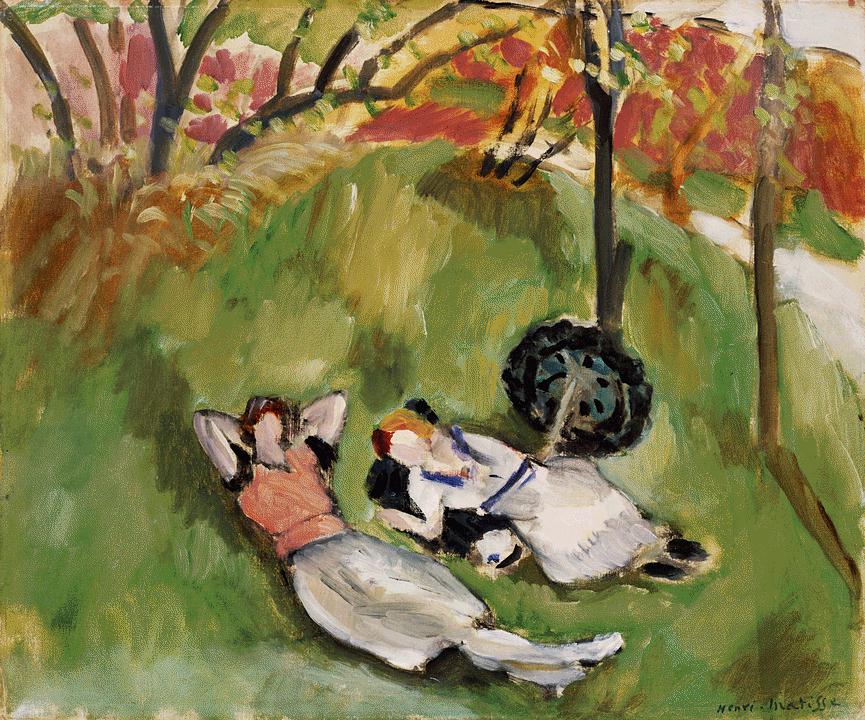
Henri Matisse Two Figures Reclining in a
Landscape 1921 Barnes Foundation
There were salient
features of British popularization of science of the nineteenth century. There
is no question that there was a growing appeal and fascination about science
all over the social spectrum in Britain. On the one hand, the
popularization of science had a strong religious dimension that aimed to convey
“right” morality and ethics to ordinary people. Hence, the message was that
science was providential and God-ordained. Furthermore, the religious dimension
of the popularization of science was one strategy to exercise social control
upon society. On the other hand, the popularization of science sought to
legitimize scientific disciplines. How? This essay aims to show the main
features of the popularization of science in the nineteenth century
in Great Britain through the following five-case studies: David
Layton’s specialized and general dictionaries, Bernard Lightman’s natural
theology, Roger Cooter’s
phrenology, Simon Shaffer’s public spectacles, and Johnathan R. Topham’s
Bridgewater Treatises.
The five case-studies of popularization of science are organized according to the author’s methodology and definitions of popular science, academic science, and popularization of science. In their respective studies, David Layton (1965), Bernard Lightman (2000), and Roger Cooter (1984) assert that there are two distinct spheres in science: popular science and academic science. Their goal is to analyze the popularization of science within popular culture. Despite the fact that Simon Shaffer (1983) does not assert the existence of such two spheres in science, he takes it for granted when he argues that public lectures served two purposes. On the one hand, public lectures instructed and conveyed a moral message to a popular audience. On the other hand, public lectures amused the British upper-classes. However, Shaffer’s study of the production of science as a performance is much more sophisticated because his goal is to find the values and norms those scientists, the upper-classes and the ruling class shared. Finally, Jonathan R. Topham (1998) studies the entire social actors involved in the communication circuit of the Bridgewater Treatises. In opposition to Layton, Lightman, and Cooter, Topham argue that it is impossible to distinguish popular culture from high culture. Moreover, he asserts that popular culture is high-culture. Topham solves the dichotomy between popular culture and academic culture by focusing on all the actors involved in the communication circuit.
Bernard Lightman’s article on “Diction and Dictionaries in the Diffusion of Scientific Knowledge” shows the growing literacy rates in eighteenth century England. Moreover, Lightman builds the grounds for the “marvelous” interest on science and its popularization in the following century. Layton argues that both specialized and general dictionaries play a crucial role in the dissemination of scientific knowledge in eighteenth century England - a time when scientific knowledge was accessible to only a few, and when classical education prevailed. Moreover, Layton asserts that these dictionaries opene7d the window to self-education for persons of humble origins. Layton argues that the role of dictionaries changed over time. Republished in 1706, “The New World of Words’ ” was a general dictionary written by a non-scientist named Edward Phillips. The main role of the “The New World of Words” was to instruct and compile a definite code of scientific knowledge. The “Lexicon Technicum” was a general scientific dictionary published in 1704. Finally, the “Encyclopaedia” was a work of reference whose goal was to lay the authority and legitimate certain scientific ideas and disciplines. These dictionaries explained in non-technical language Newtonian mechanics, mathematics, astronomy, botany, and medicine. Layton’s aim is to study the popularization of science throughout the spread of general and specialized dictionaries. However, his definition of popularization – “as the existence of a reading public interested in science”[1] - does not match with the studies of his dictionaries. He does not explore the thoughts, values, norms, and views of ordinaryk people. Finally, Layton remains focused on members of the elite: those who wrote the dictionaries.
Along these same lines, Bernard Lightman analyzes how both natural theology and chemical retina were popularized in nineteenth century Great Britain. Following, the careers of these three, “popularizes” of natural theology: J. G. Wood, Richard Proctor and Agnes Clerke. Their articles of natural theology, in which science went together with religion, were the strategy to reach a broad audience. Lightman argues that those three “popularizers” of science transformed natural theology tradition by using mass visual culture and by ignoring the meanings that their audiences gave to their sermon-like lectures. Lightman’s important contribution is that he articulates the relationship between natural theology and religion. Lightman purports to analyze popular culture and achieves it. For example, Bernad Lightman presents Agnes Clarke as a “popularizers” of science. She was part of the scientific establishment. She became an honorary member of the Royal Astronomic Academy in 1903. Agnes Clerke was useful to the astronomers and Royal Astronomy’s interests because she popularized the astronom\y they wanted to be conveyed to ordinary people. On the other hand, Lightman does not provide a definition of popular culture and popularization of science. What does he mean by the use of that term? His ideas of both “popular culture” and “science” are unclear and diffuse. Lightman believes that by the means of depicting the spectacles and by the use of mass visual culture as a strategy to reach the popular audience, he is able to reach the cultural and social implications of the natural theology of ordinary people. Finally, Lightman’s study focuses on the intermediaries of science, rather than on ordinary people or the popular audience.
Building upon Layton and Lightman, Roger Cooter draws the difference between popular science and academic science as separate spheres of science. Cooter prefers to analyze the cultural and social meanings of phrenology in popular culture. In contrast, in academic science, phrenology became a vehicle of liberal ideology that led to major reforms in criminology, education, the treatment of the insane in the Anglo-Saxon world. His narrative is not easy to follow. His attempts to define concepts and draw ideas from outside of the Anglo-Saxon tradition make his English awkward to read. However, Cooter’s prosopographical study of phrenology is superb. He distinguishes phrenologists from antiphrenologists with the following categories: age, prestige, power, income, religion, and identity. Cooter asserts that phrenologists were in their forties, lacked sufficient power or prestige within academia, did not belong to the established Church, and had a sense of “social worth”.[2] Nevertheless, they were neither political nor economic radicals, they were professionals trying to legitimize a new discipline and struggling to find a place within academia. Cooter faces the same problem as Lightman: their concept of popular culture is high-culture. Cooter explains how phrenology moved from academic social circles to popular audiences in the middle of the nineteenth century. Once phrenology entered the realm of the popular audience, scientists regreted its popularization. Because the use of phrenology by a popular audience automatically makes it lose status in the eyes of academic science. What is more, phrenology becomes vulgar once in the hands of a popular audience. Moreover, antiphrenologists lamented the degeneration of a field rooted in the disciplines of physiology and anatomy. Cooter carries on an excellent study of the social and cultural meanings of phrenology focusing on both scientists and its intermediaries. He has difficulties in understanding the codes, texts, meanings, and significance of phrenology for ordinary people.
Simon Shaffer writes a short masterpiece about the importance of the public spectacle in the production and legitimatization of experimental natural philosophy in the eighteenth century in England. He deploys rigorous definitions of audience, rhetoric, scientific production, and natural philosophy. The most interesting aspect of the article is his explanation of the significance of public spectacles, both due to their educational role and their role of turning into a theatre for the upper-classes. Shaffer thoroughly unveils values and accepted social conventions in the form of “powers of matter”, the sublime, the aesthetics of the sublime and the beautiful, and the epistemology of controlled experience. Natural philosophers as well as the educated and wealthy English society shared the above mentioned values and norms. Moreover, Shaffer argues that experimental natural philosophy’s legitimacy was based on norms and values of the eighteenth century English gentlemanly society.l
Jonathan Topham highlights the significance of the popularization of Bridgewater Treatesis’ in the 1930s in England. Topham contends Robert M. Young’s “common intellectual context”[3]. Young argues that at the beginning of the nineteenth century, British intelligentsia shared a homogenous intellectual context due to the broad circulation of literature books and a strong belief in natural theology. In opposition to Young, Topham argues that the Bridgewater Treatesis had multiple meanings rather than a homogenous interpretation. Each reader invested its own meaning to the Treatesis, and thus he studies the different actors of the communication circle of the production of books. His goal is to disclose how those authors, publishers, booksellers, bookbinders, printers, and readers influenced the readership. Topham makes a subtle distinction among readers: gentlemen of science, middle-class domesticity, the public arena, and radical artists.
Jonathan R. Topham (1998) asserts the need to study the whole range of social actors of the communication circle to understand the popularization of science. Lets start with the authors of the Bridgewater Treatesis. The authors of the Bridgewater Treatesis did not have a clear purpose. On the contrary, an ambiguity regarding the author’s purpose, the content, the intention, the audience, and the genre was an outstanding feature of the Bridgewater Treatesis. The Treatesis’ genre did not fit into a traditional one; it was reviewed both by religious and specialist journalists. In addition, the readership was wide. The readership varied from experts to lay people. Neither were the Treatesis intended for a particular audience which could vary from Oxford educated men to artisans. The unclear strategy of the authors widened its readership.
The following three paragraphs will analyze the publishers, printers, and booksellers’ purposes with regard to the price, format, and content of the Bridgewater Treatesis. The publishers’ had control over the choice of the material form and upon the purpose of the Treatesis. The publisher's main purpose was to dignify the Treatesis. The authors of the Bridgewater looked for the best publishers in London. The first publisher was John Murray who offered a better commercial offer in comparison to Longman. Murray’s presented them as a new genre called popular science. On the contrary, Pickering, who published the second edition, had a clear-cut commercial purpose. Therefore, the Bridgewater Treatesis had an expensive price and were presented as theological works. Pickering’s buyers were wealthy and educated: the aristocracy, the gentry, and the upper-classes. Topham argues that despite the publisher’s purposes, the Treatesis turned into a commercial success because they were sold and read by a wide audience.
Printers, booksellers and bookbinders had important roles. The printers played a key role because Whittingham provided credit to Pickering. Moreover, both printer and publisher agreed on high-quality typography and were against a cheap edition of the Treatises. Nevertheless, as the audience broadened, they had no alternative but to sell a cheap edition. The booksellers were retailers. Pickering sold the Treatesis to antiquaries, bibliophiles, and to buyers of the countryside market. The commercial success of the Treatesis empowered Pickering. Finally, bookbinders chose the presentation of the publication: the coloring, cotton-cloth, and the leader binding. The bookbinding tells us about the wealth of the readers rather than the durability of the books.
Topham divides the readership into four dimensions: gentlemen of science, socialites, middle-class domesticity, and radical artists. Each group invested a particular meaning to the Bridgewater Treatises that led to competing ideas of nature and the place of science.
Topham’s goal is to recreate the social world of the readers. His main historical sources are reviews, conversations, sermons, lectures, and addresses. The gentlemen of science read the Treatesis for the sake of maintaining their reputation as scientific experts. Topham focuses on Buckland’s geology. He argues that William Buckland fought for his reputation as an author creating expectation, spreading rumors, carrying on intimate conversations, and writing reviews about the future publication of this geology.
It became fashionable to read the Bridgewater Treatesis because their role was to preserve the existence of a select readership. It was a way to reject the fact that ordinary people were interested in reading the Treatesis. Another important role of the fashionable society was to create a public opinion after soires, converzationes, and dinner parties. William Buckland’s geology also provided a topic of conversation not only within the heart of middle-class domesticity, but also between young men and women. Buckland’s science was morally safe; moreover it highlighted the importance of sublime and wonders.
Both geologists and radical artists threatened the cultural and social authority of the arts and scientific academic bodies. Gentlemen of science consolidated their cultural authority through the British Association. The religious tendency of Buckland’s geology led to a conflict with the British Association. The conflict became a public spectacle. Topham argues that the public spectacle between the geologists and the British Association demonstrate how books turn into contested objects. Topham gives evidence of the multiple meanings given to the Treatesis. Artisans undermined gentlemen’s scientific authority because they had a materialist understanding of science. At the same time, gentlemen of science hold to the idea of providential nature of science. Carlileans, Owenites, and Chartists shared the antireligious end of science.
Layton, Lightman, and Cooter’s flaw is their belief in the split between popular culture and high-culture. I argue that popular culture is high culture because of the impossibility of finding texts, historical sources, and codes that tell us what ordinary people thought. The three scholars study popular culture focusing on intermediaries who devoted part of their lives to preaching, instructing, and publicizing science. However, those intermediaries do not tell us about the meaning that ordinary people gave to science. What is more, those intermediaries were literate and were even recognized members of scientific circles. The attempt to study the cultural and social meanings of science upon ordinary people is worthwhile and necessary. However, I contend with the methodology and the historical sources to reach that goal. Shaffer has a much more sophisticated analysis of the historical sources. He concentrates on values shared by both natural scientists and gentlemanly society: sublime, beauty, wonder, spectacle, and aesthetics are the main characters of the scientific stage. Shaffer’s contribution is to define scientific production as spectacle. Thus, he questions the authority of certain disciplines and shows their strategies to become legitimate fields of study. Topham broadens the actors and their purposes within the popularization of science. Topham claims that radical artists and scriptural geologists threatened and undermined the scientific authority of English gentlemen of science. Morrell and Thrackray argue that the gentleman of science’s central ideology was an emphasis on the relationship between science and religion. At the same time, Chartists, Carlileans, Owenists, and scriptural geologists challenged that view of science. The former ones supported a materialists and non-religious worldview of science. The latter conveyed a religious understanding of geology. The conclusion is that the concept of science had different meanings depending on who read it.
The readership interested in science broadened. Moreover, there were groups – dictionary authors, science popularizers, phrenologists, and scriptural geologists – that both popularized science and even challenged the place of science. Science had become marvelous, beautiful, and mysterious in the eyes of both upper-middle classes and ordinary people. In addition, the religious dimension of science becomes more important. The English gentlemen of science related science to a providential idea of religion. On the contrary, radical artists developed a materialist and non-religious view of science. The popularizers of natural theology – J. G. Wood, Richard Proctor and Clerke – also conveyed a moral and religious message. Finally, the popularization of science sought to legitimaze scientific disciplines. Phrenologists fiercely fought to legitimize their new field. Nineteenth century Britain marveled at scientific spectacles and discoveries. The unsolved problem is which was the best way to explain and interpret science popularization; does academic culture belong to a distinct sphere from popular science? Is the communication circuit an interesting approach to understand the popularization of science? Are there relationships that link academic science to popular science? Where intermediaries of science should be placed?
GeorgetownUniversity
Department of History
The five case-studies of popularization of science are organized according to the author’s methodology and definitions of popular science, academic science, and popularization of science. In their respective studies, David Layton (1965), Bernard Lightman (2000), and Roger Cooter (1984) assert that there are two distinct spheres in science: popular science and academic science. Their goal is to analyze the popularization of science within popular culture. Despite the fact that Simon Shaffer (1983) does not assert the existence of such two spheres in science, he takes it for granted when he argues that public lectures served two purposes. On the one hand, public lectures instructed and conveyed a moral message to a popular audience. On the other hand, public lectures amused the British upper-classes. However, Shaffer’s study of the production of science as a performance is much more sophisticated because his goal is to find the values and norms those scientists, the upper-classes and the ruling class shared. Finally, Jonathan R. Topham (1998) studies the entire social actors involved in the communication circuit of the Bridgewater Treatises. In opposition to Layton, Lightman, and Cooter, Topham argue that it is impossible to distinguish popular culture from high culture. Moreover, he asserts that popular culture is high-culture. Topham solves the dichotomy between popular culture and academic culture by focusing on all the actors involved in the communication circuit.
Bernard Lightman’s article on “Diction and Dictionaries in the Diffusion of Scientific Knowledge” shows the growing literacy rates in eighteenth century England. Moreover, Lightman builds the grounds for the “marvelous” interest on science and its popularization in the following century. Layton argues that both specialized and general dictionaries play a crucial role in the dissemination of scientific knowledge in eighteenth century England - a time when scientific knowledge was accessible to only a few, and when classical education prevailed. Moreover, Layton asserts that these dictionaries opene7d the window to self-education for persons of humble origins. Layton argues that the role of dictionaries changed over time. Republished in 1706, “The New World of Words’ ” was a general dictionary written by a non-scientist named Edward Phillips. The main role of the “The New World of Words” was to instruct and compile a definite code of scientific knowledge. The “Lexicon Technicum” was a general scientific dictionary published in 1704. Finally, the “Encyclopaedia” was a work of reference whose goal was to lay the authority and legitimate certain scientific ideas and disciplines. These dictionaries explained in non-technical language Newtonian mechanics, mathematics, astronomy, botany, and medicine. Layton’s aim is to study the popularization of science throughout the spread of general and specialized dictionaries. However, his definition of popularization – “as the existence of a reading public interested in science”[1] - does not match with the studies of his dictionaries. He does not explore the thoughts, values, norms, and views of ordinaryk people. Finally, Layton remains focused on members of the elite: those who wrote the dictionaries.
Along these same lines, Bernard Lightman analyzes how both natural theology and chemical retina were popularized in nineteenth century Great Britain. Following, the careers of these three, “popularizes” of natural theology: J. G. Wood, Richard Proctor and Agnes Clerke. Their articles of natural theology, in which science went together with religion, were the strategy to reach a broad audience. Lightman argues that those three “popularizers” of science transformed natural theology tradition by using mass visual culture and by ignoring the meanings that their audiences gave to their sermon-like lectures. Lightman’s important contribution is that he articulates the relationship between natural theology and religion. Lightman purports to analyze popular culture and achieves it. For example, Bernad Lightman presents Agnes Clarke as a “popularizers” of science. She was part of the scientific establishment. She became an honorary member of the Royal Astronomic Academy in 1903. Agnes Clerke was useful to the astronomers and Royal Astronomy’s interests because she popularized the astronom\y they wanted to be conveyed to ordinary people. On the other hand, Lightman does not provide a definition of popular culture and popularization of science. What does he mean by the use of that term? His ideas of both “popular culture” and “science” are unclear and diffuse. Lightman believes that by the means of depicting the spectacles and by the use of mass visual culture as a strategy to reach the popular audience, he is able to reach the cultural and social implications of the natural theology of ordinary people. Finally, Lightman’s study focuses on the intermediaries of science, rather than on ordinary people or the popular audience.
Building upon Layton and Lightman, Roger Cooter draws the difference between popular science and academic science as separate spheres of science. Cooter prefers to analyze the cultural and social meanings of phrenology in popular culture. In contrast, in academic science, phrenology became a vehicle of liberal ideology that led to major reforms in criminology, education, the treatment of the insane in the Anglo-Saxon world. His narrative is not easy to follow. His attempts to define concepts and draw ideas from outside of the Anglo-Saxon tradition make his English awkward to read. However, Cooter’s prosopographical study of phrenology is superb. He distinguishes phrenologists from antiphrenologists with the following categories: age, prestige, power, income, religion, and identity. Cooter asserts that phrenologists were in their forties, lacked sufficient power or prestige within academia, did not belong to the established Church, and had a sense of “social worth”.[2] Nevertheless, they were neither political nor economic radicals, they were professionals trying to legitimize a new discipline and struggling to find a place within academia. Cooter faces the same problem as Lightman: their concept of popular culture is high-culture. Cooter explains how phrenology moved from academic social circles to popular audiences in the middle of the nineteenth century. Once phrenology entered the realm of the popular audience, scientists regreted its popularization. Because the use of phrenology by a popular audience automatically makes it lose status in the eyes of academic science. What is more, phrenology becomes vulgar once in the hands of a popular audience. Moreover, antiphrenologists lamented the degeneration of a field rooted in the disciplines of physiology and anatomy. Cooter carries on an excellent study of the social and cultural meanings of phrenology focusing on both scientists and its intermediaries. He has difficulties in understanding the codes, texts, meanings, and significance of phrenology for ordinary people.
Simon Shaffer writes a short masterpiece about the importance of the public spectacle in the production and legitimatization of experimental natural philosophy in the eighteenth century in England. He deploys rigorous definitions of audience, rhetoric, scientific production, and natural philosophy. The most interesting aspect of the article is his explanation of the significance of public spectacles, both due to their educational role and their role of turning into a theatre for the upper-classes. Shaffer thoroughly unveils values and accepted social conventions in the form of “powers of matter”, the sublime, the aesthetics of the sublime and the beautiful, and the epistemology of controlled experience. Natural philosophers as well as the educated and wealthy English society shared the above mentioned values and norms. Moreover, Shaffer argues that experimental natural philosophy’s legitimacy was based on norms and values of the eighteenth century English gentlemanly society.l
Jonathan Topham highlights the significance of the popularization of Bridgewater Treatesis’ in the 1930s in England. Topham contends Robert M. Young’s “common intellectual context”[3]. Young argues that at the beginning of the nineteenth century, British intelligentsia shared a homogenous intellectual context due to the broad circulation of literature books and a strong belief in natural theology. In opposition to Young, Topham argues that the Bridgewater Treatesis had multiple meanings rather than a homogenous interpretation. Each reader invested its own meaning to the Treatesis, and thus he studies the different actors of the communication circle of the production of books. His goal is to disclose how those authors, publishers, booksellers, bookbinders, printers, and readers influenced the readership. Topham makes a subtle distinction among readers: gentlemen of science, middle-class domesticity, the public arena, and radical artists.
Jonathan R. Topham (1998) asserts the need to study the whole range of social actors of the communication circle to understand the popularization of science. Lets start with the authors of the Bridgewater Treatesis. The authors of the Bridgewater Treatesis did not have a clear purpose. On the contrary, an ambiguity regarding the author’s purpose, the content, the intention, the audience, and the genre was an outstanding feature of the Bridgewater Treatesis. The Treatesis’ genre did not fit into a traditional one; it was reviewed both by religious and specialist journalists. In addition, the readership was wide. The readership varied from experts to lay people. Neither were the Treatesis intended for a particular audience which could vary from Oxford educated men to artisans. The unclear strategy of the authors widened its readership.
The following three paragraphs will analyze the publishers, printers, and booksellers’ purposes with regard to the price, format, and content of the Bridgewater Treatesis. The publishers’ had control over the choice of the material form and upon the purpose of the Treatesis. The publisher's main purpose was to dignify the Treatesis. The authors of the Bridgewater looked for the best publishers in London. The first publisher was John Murray who offered a better commercial offer in comparison to Longman. Murray’s presented them as a new genre called popular science. On the contrary, Pickering, who published the second edition, had a clear-cut commercial purpose. Therefore, the Bridgewater Treatesis had an expensive price and were presented as theological works. Pickering’s buyers were wealthy and educated: the aristocracy, the gentry, and the upper-classes. Topham argues that despite the publisher’s purposes, the Treatesis turned into a commercial success because they were sold and read by a wide audience.
Printers, booksellers and bookbinders had important roles. The printers played a key role because Whittingham provided credit to Pickering. Moreover, both printer and publisher agreed on high-quality typography and were against a cheap edition of the Treatises. Nevertheless, as the audience broadened, they had no alternative but to sell a cheap edition. The booksellers were retailers. Pickering sold the Treatesis to antiquaries, bibliophiles, and to buyers of the countryside market. The commercial success of the Treatesis empowered Pickering. Finally, bookbinders chose the presentation of the publication: the coloring, cotton-cloth, and the leader binding. The bookbinding tells us about the wealth of the readers rather than the durability of the books.
Topham divides the readership into four dimensions: gentlemen of science, socialites, middle-class domesticity, and radical artists. Each group invested a particular meaning to the Bridgewater Treatises that led to competing ideas of nature and the place of science.
Topham’s goal is to recreate the social world of the readers. His main historical sources are reviews, conversations, sermons, lectures, and addresses. The gentlemen of science read the Treatesis for the sake of maintaining their reputation as scientific experts. Topham focuses on Buckland’s geology. He argues that William Buckland fought for his reputation as an author creating expectation, spreading rumors, carrying on intimate conversations, and writing reviews about the future publication of this geology.
It became fashionable to read the Bridgewater Treatesis because their role was to preserve the existence of a select readership. It was a way to reject the fact that ordinary people were interested in reading the Treatesis. Another important role of the fashionable society was to create a public opinion after soires, converzationes, and dinner parties. William Buckland’s geology also provided a topic of conversation not only within the heart of middle-class domesticity, but also between young men and women. Buckland’s science was morally safe; moreover it highlighted the importance of sublime and wonders.
Both geologists and radical artists threatened the cultural and social authority of the arts and scientific academic bodies. Gentlemen of science consolidated their cultural authority through the British Association. The religious tendency of Buckland’s geology led to a conflict with the British Association. The conflict became a public spectacle. Topham argues that the public spectacle between the geologists and the British Association demonstrate how books turn into contested objects. Topham gives evidence of the multiple meanings given to the Treatesis. Artisans undermined gentlemen’s scientific authority because they had a materialist understanding of science. At the same time, gentlemen of science hold to the idea of providential nature of science. Carlileans, Owenites, and Chartists shared the antireligious end of science.
Layton, Lightman, and Cooter’s flaw is their belief in the split between popular culture and high-culture. I argue that popular culture is high culture because of the impossibility of finding texts, historical sources, and codes that tell us what ordinary people thought. The three scholars study popular culture focusing on intermediaries who devoted part of their lives to preaching, instructing, and publicizing science. However, those intermediaries do not tell us about the meaning that ordinary people gave to science. What is more, those intermediaries were literate and were even recognized members of scientific circles. The attempt to study the cultural and social meanings of science upon ordinary people is worthwhile and necessary. However, I contend with the methodology and the historical sources to reach that goal. Shaffer has a much more sophisticated analysis of the historical sources. He concentrates on values shared by both natural scientists and gentlemanly society: sublime, beauty, wonder, spectacle, and aesthetics are the main characters of the scientific stage. Shaffer’s contribution is to define scientific production as spectacle. Thus, he questions the authority of certain disciplines and shows their strategies to become legitimate fields of study. Topham broadens the actors and their purposes within the popularization of science. Topham claims that radical artists and scriptural geologists threatened and undermined the scientific authority of English gentlemen of science. Morrell and Thrackray argue that the gentleman of science’s central ideology was an emphasis on the relationship between science and religion. At the same time, Chartists, Carlileans, Owenists, and scriptural geologists challenged that view of science. The former ones supported a materialists and non-religious worldview of science. The latter conveyed a religious understanding of geology. The conclusion is that the concept of science had different meanings depending on who read it.
The readership interested in science broadened. Moreover, there were groups – dictionary authors, science popularizers, phrenologists, and scriptural geologists – that both popularized science and even challenged the place of science. Science had become marvelous, beautiful, and mysterious in the eyes of both upper-middle classes and ordinary people. In addition, the religious dimension of science becomes more important. The English gentlemen of science related science to a providential idea of religion. On the contrary, radical artists developed a materialist and non-religious view of science. The popularizers of natural theology – J. G. Wood, Richard Proctor and Clerke – also conveyed a moral and religious message. Finally, the popularization of science sought to legitimaze scientific disciplines. Phrenologists fiercely fought to legitimize their new field. Nineteenth century Britain marveled at scientific spectacles and discoveries. The unsolved problem is which was the best way to explain and interpret science popularization; does academic culture belong to a distinct sphere from popular science? Is the communication circuit an interesting approach to understand the popularization of science? Are there relationships that link academic science to popular science? Where intermediaries of science should be placed?
GeorgetownUniversity
Department of History
[1] David Layton, “Diction and Dictionaries in the Diffusion of Scientific Knowledge” , British Journal for History of Science, 77 (September, 1965): 226.
[2] David Lightman, “The Visual Theology of Victorian Popuarizers of Science: From Reverent Eye to Chemical Retina”, Isis, 91, No 4 (Dec., 2000): 679
[3] Jonatham Topham,”Beyond the “Common Context”: The Production and reading of Bridgewater Treatesis”, Isis, Vol. 89, no 2 (June, 1998): 234
@8. Science, Politics and Nationhood in XIXth
Cetuary France. The popularization of Science in XIXth
in France: Arts and Humanities
Notre-Dame,
une fin d'après-midi (A Glimpse of Notre Dame in the Late Afternoon) 1902
Albright-Knox Art Gallery, Buffalo, NY
Maurice Crossland’s article about popularization of science in
nineteenth century France: Science and the Arts: challenges to authority
in France under the Second Empire.
Scholars have meticulously studied the cultural and social dimensions of science of the Victorian period. Maurice Crossland’s article about science and the arts under the Second Empire is an important contribution to the popularization of science in France because it readers enables to draw comparisons between the popularization of science on both sides of the English Channel. Crossland draws similarities among science journalists, Impressionists, and “realist” novelists. Crossland argues that science writers carved a new full-time occupation to which they attached a counter-culture that threatened the authority of official science embodied in the Académie des Sciences. Their counter-culture consisted on translating technical science into more understandable language for a broad public interested in science. Moreover, science popularizers undermined the authority of the Académie des Sciences because they knew they had no chances to become members of the prestigious institution. Crossland follows the careers of three popularizers of science under the Second Empire and brings to light the way they carved out a full-time occupation; they were Frederic Moigno (1804-1884), Victor Meunir (1817-1903), and Louis Figuier (1819-1894). The Académie was an easy target and at the same time to legitimize their role as science writers. Moreover, they strengthened solidarity ties that turned them into a self-conscious group who would threaten the authority of “official science”. Crossland also analyses the aims of science writers and their counter-culture. He stresses the similarities with other innovative movements: Impressionists and science fiction writer, particularly the figure of Jules Verne.
Crossland studies three science writers’ success because their articles, journals, and books were widely read by a broad audience. Their common feature is that the three of them worked as science correspondents for La Presse. Crossland argues that working as a science journalist in La Presse served as an apprenticeship for developing science writing as a pioneering occupation in France. The first science correspondent of La Presse was Frederic Moigno (1804-1884). He was a Jesuit mathematician that had to quit the order. In the need to make ends meet, he used his math knowledge to find a new job. He worked as a journalist at L’ Epoque until he was hired as science correspondent of La Presse from 1848 to 1851. Finally, he became an editor of the weekly science journal Cosmos. On the same lines, Victor Meunir (1817-1903) was a clerk who attended the science courses of Musée d’ Histoire Naturelle and Jacques Arago’s lectures too. He supported left wing politics. He replaced Moigno as a science correspondent of Le Presse from 1851 to 1855. Later, he founded his own journal named L’ Amis des sciences. Louis Figuier (1819-1894) took the place of Meunir post as science journalist in 1857. Figuier had been a professor at the École de Pharmacy at Montpellier and suffered from the academicians’ public humiliation. He quit his position at the university and started writing biographies of chemists. In 1857, Figuier launched his own journal called L’ Anee Scientific e Industrielle that became successful commercial enterprise in 1864. Moigno, Meunier, and Figuier were pioneers in fashioning a new role for science writers whose main features were to write about science and to have a critical approach towards official science. Moreover, they gave shape to what a science writer was; a full-time occupation of which they could make ends meet.
Crossland demonstrates that the science writers developed both a critical outlook towards the Académie of Science and solidarity ties. Crossland gives strong evidence of science writers’ role as critics. Science writers started reporting the sessions of the Comtes Rendus - 1835 - and the meetings of the Académie. Unsatisfied with the reports of the Académie, their science writer’s task turned into an explicit criticism toward individuals or theories supported by the national body of science. This critical stand increased under the elitist and authoritarian Seconde Empire. For example, Figuier defended Pouchet and wrote that Pasteur was an uncritical scientist who preferred to be pampered and protected by the Academy. Popularization of science began in the press and the science writer’s aim was to destroy prejudices and attack false opinions. Their role, however, went beyond instruction and turned into criticism of the prestigious Académie of Sciences. Crossland draws an interesting parallelism in the method of publishing among science writers, artists, and novelists. Figuier, Moigno, Meunier, as well as Emile Zola, Alexander Dumas, Jorge Sand and Jules Verne, first published their works in newspapers and journals, lateR they would become books. However, Crossland falters by asserting that this critical stance is evidence of solidarity ties. Moreover, the evidence of the solidarity ties grown out of the practice of a shared occupation is weak. Crossland asserts the science journalist’s camaraderie due to formal organizations and the sense of camaraderie. In 1857, Figuer founded the Cercle de la Presse Scientifique together with two other science journalists nevertheless they did not keep written records of their meetings. Two fellow science journalists: Lecouturier (Le Pays) and Felix Foubaud (L’Illustration). The three shared the goal of strengthening the links between science journalism and contributing to the progress of science. Along the same lines the evidence for the feeling of solidarity are difficult to trace. Crossland asserts that the tribute that Figuier paid tribute to Moigno and Berthoud as the pioneers of science popularization is good evidence of their feelings of solidarity. I wonder /contend that undermining the authority of the Académie is evidence of solidarity ties.
Crossland isolates these groups as self-conscious. Furthermore, they build up a counter-culture that clashed with the official culture. Science writers’ goals were to write and sell their works about science to a broad public rather than to become members of the Académie. They were conscious of their role of outsiders, particularly Figuier who failed at his attempt to argue against a scientific theory held by the Académie. Freedom and independence from the Academy made up for the two main features of their counter-culture. Moreover, their identity was grounded in their popularity. Freedom was further more important than political stances. Therefore, their critical stance against the Académie led them to develop their counter-culture. Meunier was a socialist. Figuier backed Louis Napoleon Empire. Moigno preferred a Christian perspective of science. However, the Académie’s defined two strategies to counterbalance the popularity of science writers: academicians popularized science and the Academy organized public lectures named Soirées de la Sorbonne. Eventually, their articles, journals and books sold out. Ordinary people accepted uncritically their writings. They could make a living out of science journalism in France.
Crossland’s main contribution is the similarities he finds among science writers, the Impressionist movement, and “realist” novelists. Crossland says that novelists, artists, and science writers shared lots of common places where they debated about politics, economics, art, science, literature and so on. Crossland focuses on the Impressionist movement and the figure of Jules Verne. The Académie des Beaux Arts rejected paintings that did not followed certain artistic standards. The Académie des Beaux Arts refused to exhibit Édouard Manet, Paul Pissaro, Alfred Sisley, and Edgard Degas’ paintings. To counteract that, Louis Napoleon acted as a mediator between the academicians and the refusées and he requested the opening of a Salon des Refusées in 1863. In response, Manet suggested an Anti-salon in 1873. They refused to exhibit their painting in the Salon des Refusées because they had organized themselves under the name of Impressionists and had their own exhibition called Anti-Salon. Despite this, the Impressionists as well as the science writers undermined the official authority. They believed in their work and they turned to the public to legitimate their work rather to the traditional authorities. What is more, both artists and science writer were eager to relate to the public. They had found a new source of legitimacy. Despite the fact that there were similarities with novelists, Crossland argues that novelists had more independence than artists or science writers. Crossland emphasizes the figures of Emile Zola and Jules Verne despite the differences between them. Emile Zola was a strong critic of different kind of authorities: art, military, politics, and literature. Zola wrote articles supporting Manet’s works of art and also Cézanne’s. On different lines, Jules Verne (1828-1903) is important in Crossland’s eyes because of his ability to blend literature and science. Verne wrote science fiction. He was aware that his work would not be considered by the Académie. On the contrary, Zola presented his candidacy to the Academy, however he was always rejected. Zola’s case demonstrates that the Académy/ise were still an important source of national recognition. Crossland highlights Verne’s coming across with Jacques Arago in 1850. He also asserts that Verne was a popularizer of science even if he did not intended to be so. Finally, Crossland asserts that Verne, the Impressionist, and science writers had in common to publish their first articles in newspapers and to have a strong belief that science led to progress. Despite all the political and purpose difference among the three groups, Crossland argues that for all of them science was a model to follow. Science led to progress; therefore ordinary people should be aware of science’s potential so as to improve their living standards and situation. The nineteenth century strongly believed that science equaled progress. Science hence became a symbol of civilization, progress, improvement, and future. Despite the opposition of science writers towards official science, their work could not be undermined because they popularized science as civilization and order.
Crossland’s science-writers distinguished from their English counterparts because they made a living out of their writings in the press and in print. A broad audience both read and was marveled by both English and French science writers. Furthermore, Crosland argues that science writes were a self-conscious group who developed solidarity ties and also undermined the scientific official culture. Crossland, hence argues that science writers moved forward into creating their own counter-culture which part of it was shared with novelists and artists. Their counter-culture opposed official science. Science writers found their legitimacy on its broad audience. On the contrary, official science’s legitimacy was grounded in their respective science communities and in the Académies’s recognition. Eventually, Crossland’s main contribution is to show the intermingling among science writers, impressionists, and novelists in France’s Second Empire[15]. However, he does not convey the social atmosphere of French society: the importance of meeting in cafes, literary circles, social gatherings, or artistic exhibitions. Crossland mentions how Arago could have influenced Verne, however their meeting and influencing each other is not the important issue to convey. Humanistic entertainment flowed France’s intellectual life. Intellectual life was not divided into scientific division; on the contrary, novelists feed and learn from science writers and artists in a common ground such as café or a party. Sometimes, intellectual events get mixed with social events; a tradition that goes back to the salons of the seventeenth century. Rather than separating novelists, impressionists from science writers, Crossland could have portrayed them as an intellectual counter-culture devoted to different interests. On the other hand, he makes a sharp distinction between official-culture and counter-culture. Nevertheless, he could have related to a growing counter-culture and the politics of the Second Empire. The Second Empire created new images and representations of science, art, government, and science. If the Académie was state-sponsored, what was the academician’s purpose: change, innovate, or go back to previous artistic movements? What are the relationships with Louis Napoleon both conservative but also liberal government? Why would Louis Napoleon become a broker between the Académie des Beaux Arts and the Impressionists? Crossland misses the values and norms of science of both the intellectual life and the government. What were science writers, novelists, and Impressionists reaction to? Crossland asserts that most of them were undermining the authority of the National Institutes. However, the National institutes were state-sponsored so the link among state, academic bodies and new artistic and scientific movements deserves further research. Georgetown
Scholars have meticulously studied the cultural and social dimensions of science of the Victorian period. Maurice Crossland’s article about science and the arts under the Second Empire is an important contribution to the popularization of science in France because it readers enables to draw comparisons between the popularization of science on both sides of the English Channel. Crossland draws similarities among science journalists, Impressionists, and “realist” novelists. Crossland argues that science writers carved a new full-time occupation to which they attached a counter-culture that threatened the authority of official science embodied in the Académie des Sciences. Their counter-culture consisted on translating technical science into more understandable language for a broad public interested in science. Moreover, science popularizers undermined the authority of the Académie des Sciences because they knew they had no chances to become members of the prestigious institution. Crossland follows the careers of three popularizers of science under the Second Empire and brings to light the way they carved out a full-time occupation; they were Frederic Moigno (1804-1884), Victor Meunir (1817-1903), and Louis Figuier (1819-1894). The Académie was an easy target and at the same time to legitimize their role as science writers. Moreover, they strengthened solidarity ties that turned them into a self-conscious group who would threaten the authority of “official science”. Crossland also analyses the aims of science writers and their counter-culture. He stresses the similarities with other innovative movements: Impressionists and science fiction writer, particularly the figure of Jules Verne.
Crossland studies three science writers’ success because their articles, journals, and books were widely read by a broad audience. Their common feature is that the three of them worked as science correspondents for La Presse. Crossland argues that working as a science journalist in La Presse served as an apprenticeship for developing science writing as a pioneering occupation in France. The first science correspondent of La Presse was Frederic Moigno (1804-1884). He was a Jesuit mathematician that had to quit the order. In the need to make ends meet, he used his math knowledge to find a new job. He worked as a journalist at L’ Epoque until he was hired as science correspondent of La Presse from 1848 to 1851. Finally, he became an editor of the weekly science journal Cosmos. On the same lines, Victor Meunir (1817-1903) was a clerk who attended the science courses of Musée d’ Histoire Naturelle and Jacques Arago’s lectures too. He supported left wing politics. He replaced Moigno as a science correspondent of Le Presse from 1851 to 1855. Later, he founded his own journal named L’ Amis des sciences. Louis Figuier (1819-1894) took the place of Meunir post as science journalist in 1857. Figuier had been a professor at the École de Pharmacy at Montpellier and suffered from the academicians’ public humiliation. He quit his position at the university and started writing biographies of chemists. In 1857, Figuier launched his own journal called L’ Anee Scientific e Industrielle that became successful commercial enterprise in 1864. Moigno, Meunier, and Figuier were pioneers in fashioning a new role for science writers whose main features were to write about science and to have a critical approach towards official science. Moreover, they gave shape to what a science writer was; a full-time occupation of which they could make ends meet.
Crossland demonstrates that the science writers developed both a critical outlook towards the Académie of Science and solidarity ties. Crossland gives strong evidence of science writers’ role as critics. Science writers started reporting the sessions of the Comtes Rendus - 1835 - and the meetings of the Académie. Unsatisfied with the reports of the Académie, their science writer’s task turned into an explicit criticism toward individuals or theories supported by the national body of science. This critical stand increased under the elitist and authoritarian Seconde Empire. For example, Figuier defended Pouchet and wrote that Pasteur was an uncritical scientist who preferred to be pampered and protected by the Academy. Popularization of science began in the press and the science writer’s aim was to destroy prejudices and attack false opinions. Their role, however, went beyond instruction and turned into criticism of the prestigious Académie of Sciences. Crossland draws an interesting parallelism in the method of publishing among science writers, artists, and novelists. Figuier, Moigno, Meunier, as well as Emile Zola, Alexander Dumas, Jorge Sand and Jules Verne, first published their works in newspapers and journals, lateR they would become books. However, Crossland falters by asserting that this critical stance is evidence of solidarity ties. Moreover, the evidence of the solidarity ties grown out of the practice of a shared occupation is weak. Crossland asserts the science journalist’s camaraderie due to formal organizations and the sense of camaraderie. In 1857, Figuer founded the Cercle de la Presse Scientifique together with two other science journalists nevertheless they did not keep written records of their meetings. Two fellow science journalists: Lecouturier (Le Pays) and Felix Foubaud (L’Illustration). The three shared the goal of strengthening the links between science journalism and contributing to the progress of science. Along the same lines the evidence for the feeling of solidarity are difficult to trace. Crossland asserts that the tribute that Figuier paid tribute to Moigno and Berthoud as the pioneers of science popularization is good evidence of their feelings of solidarity. I wonder /contend that undermining the authority of the Académie is evidence of solidarity ties.
Crossland isolates these groups as self-conscious. Furthermore, they build up a counter-culture that clashed with the official culture. Science writers’ goals were to write and sell their works about science to a broad public rather than to become members of the Académie. They were conscious of their role of outsiders, particularly Figuier who failed at his attempt to argue against a scientific theory held by the Académie. Freedom and independence from the Academy made up for the two main features of their counter-culture. Moreover, their identity was grounded in their popularity. Freedom was further more important than political stances. Therefore, their critical stance against the Académie led them to develop their counter-culture. Meunier was a socialist. Figuier backed Louis Napoleon Empire. Moigno preferred a Christian perspective of science. However, the Académie’s defined two strategies to counterbalance the popularity of science writers: academicians popularized science and the Academy organized public lectures named Soirées de la Sorbonne. Eventually, their articles, journals and books sold out. Ordinary people accepted uncritically their writings. They could make a living out of science journalism in France.
Crossland’s main contribution is the similarities he finds among science writers, the Impressionist movement, and “realist” novelists. Crossland says that novelists, artists, and science writers shared lots of common places where they debated about politics, economics, art, science, literature and so on. Crossland focuses on the Impressionist movement and the figure of Jules Verne. The Académie des Beaux Arts rejected paintings that did not followed certain artistic standards. The Académie des Beaux Arts refused to exhibit Édouard Manet, Paul Pissaro, Alfred Sisley, and Edgard Degas’ paintings. To counteract that, Louis Napoleon acted as a mediator between the academicians and the refusées and he requested the opening of a Salon des Refusées in 1863. In response, Manet suggested an Anti-salon in 1873. They refused to exhibit their painting in the Salon des Refusées because they had organized themselves under the name of Impressionists and had their own exhibition called Anti-Salon. Despite this, the Impressionists as well as the science writers undermined the official authority. They believed in their work and they turned to the public to legitimate their work rather to the traditional authorities. What is more, both artists and science writer were eager to relate to the public. They had found a new source of legitimacy. Despite the fact that there were similarities with novelists, Crossland argues that novelists had more independence than artists or science writers. Crossland emphasizes the figures of Emile Zola and Jules Verne despite the differences between them. Emile Zola was a strong critic of different kind of authorities: art, military, politics, and literature. Zola wrote articles supporting Manet’s works of art and also Cézanne’s. On different lines, Jules Verne (1828-1903) is important in Crossland’s eyes because of his ability to blend literature and science. Verne wrote science fiction. He was aware that his work would not be considered by the Académie. On the contrary, Zola presented his candidacy to the Academy, however he was always rejected. Zola’s case demonstrates that the Académy/ise were still an important source of national recognition. Crossland highlights Verne’s coming across with Jacques Arago in 1850. He also asserts that Verne was a popularizer of science even if he did not intended to be so. Finally, Crossland asserts that Verne, the Impressionist, and science writers had in common to publish their first articles in newspapers and to have a strong belief that science led to progress. Despite all the political and purpose difference among the three groups, Crossland argues that for all of them science was a model to follow. Science led to progress; therefore ordinary people should be aware of science’s potential so as to improve their living standards and situation. The nineteenth century strongly believed that science equaled progress. Science hence became a symbol of civilization, progress, improvement, and future. Despite the opposition of science writers towards official science, their work could not be undermined because they popularized science as civilization and order.
Crossland’s science-writers distinguished from their English counterparts because they made a living out of their writings in the press and in print. A broad audience both read and was marveled by both English and French science writers. Furthermore, Crosland argues that science writes were a self-conscious group who developed solidarity ties and also undermined the scientific official culture. Crossland, hence argues that science writers moved forward into creating their own counter-culture which part of it was shared with novelists and artists. Their counter-culture opposed official science. Science writers found their legitimacy on its broad audience. On the contrary, official science’s legitimacy was grounded in their respective science communities and in the Académies’s recognition. Eventually, Crossland’s main contribution is to show the intermingling among science writers, impressionists, and novelists in France’s Second Empire[15]. However, he does not convey the social atmosphere of French society: the importance of meeting in cafes, literary circles, social gatherings, or artistic exhibitions. Crossland mentions how Arago could have influenced Verne, however their meeting and influencing each other is not the important issue to convey. Humanistic entertainment flowed France’s intellectual life. Intellectual life was not divided into scientific division; on the contrary, novelists feed and learn from science writers and artists in a common ground such as café or a party. Sometimes, intellectual events get mixed with social events; a tradition that goes back to the salons of the seventeenth century. Rather than separating novelists, impressionists from science writers, Crossland could have portrayed them as an intellectual counter-culture devoted to different interests. On the other hand, he makes a sharp distinction between official-culture and counter-culture. Nevertheless, he could have related to a growing counter-culture and the politics of the Second Empire. The Second Empire created new images and representations of science, art, government, and science. If the Académie was state-sponsored, what was the academician’s purpose: change, innovate, or go back to previous artistic movements? What are the relationships with Louis Napoleon both conservative but also liberal government? Why would Louis Napoleon become a broker between the Académie des Beaux Arts and the Impressionists? Crossland misses the values and norms of science of both the intellectual life and the government. What were science writers, novelists, and Impressionists reaction to? Crossland asserts that most of them were undermining the authority of the National Institutes. However, the National institutes were state-sponsored so the link among state, academic bodies and new artistic and scientific movements deserves further research. Georgetown
Georgetown University
Department of History
Department of History
Bibliography
Carolus Linnaeus, Systema
Naturae (10th ed, 1758), in Dutch Classics in the History of
Science, vol. 8 (Nieuwkoop, the Netherlands: B. de Graaf, 1964)
Georges-Louis Leclerc,
Comte de Buffon, “Initial Discourse” to Histoire Naturelle (1749),
trans. John Lyon, in From Natural History to the History of Nature:
Readings from Buffon and His Critics, eds John Lyon and Phillip R. Sloan
(Notre Dame: University of Notre Dame Press, 1981), pp. 97-128.
Jean L. R.
D’Alembert, Preliminary Discourse to the Encyclopedia of Diderot,
trans. Richard Schwab (Indianapolis: Bobbs-Merrill 1963), pp. 3-14.
Required secondary
reading:
Robert Darnton, “Google
& the Future of Books,” The New York Review of Books, 56,
no. 2 (12 February 2009): http://www.nybooks.com/articles/22281
Dorinda Outram, The
Enlightenment (Cambridge: Cambridge University Press, 1995), pp.
47-79.
Bibliography
- Ferguson,
Niall, Germany and the Origins of the First World War: New Perspectives The
historical Journal, vol. 35, issue 3, 1992, p 725-52.
Anderson, Benedict, Imagined communities: reflections on
the origin and spread of nationalism (London: Verso, 1983)
Bakhtin, M. M. (Mikhail Mikhailovich), The dialogic imagination (Austin:
University of Texas Press, 1981)
Bakhtin, M. M. (Mikhail Mikhailovich), Rabelais and his world
(Bloomington, Ind. : Indiana University Press, 1984)
Bigsby, C W, “The
Politics of Popular Culture” , Cultures I, 1973: 15-37.
Burke, Peter, Popular culture in early modern Europe (New York : Harper
&
Row, 1978,
1981)
Cooter, Roger, The cultural meaning of popular science :
phrenology and the organization of consent in nineteenth-century Britain
(Cambridge: New York: Cambridge University Press, 1984)
Cooter, Roger and Stephen Pumfrey “Separate Spheres and Public Places:
Reflections on the History of Science Popularization and Science in Popular
Culture”, History of Science 32, 1994) : 237-267.
Creager, Angela
N.H., Elizabeth A. Lunbeck & Londa Schiebinger,
Feminism in twentieth-century science, technology, and
medicine (Chicago: University of Chicago
Press, 2001)
Crossland, Maurice, Popular Science and the Arts: challenges
to Cultural authority in France under the Second Empire, British
Journal of History of Science, 2001.
Dansette, Adrien, Naissance de la France moderne :
le Second Empire (Paris: Hachette, 1976)
Darnton Robert, The Brissot
Dossier, French Historical Studies, Vol. 17, No. 1.
(Spring, 1991), pp. 191-205.
Darnton, Robert, Sounding the
Literary Marketing Prerevolutionary France, Eighteenth-Century
Studies, Vol. 17, No. 4, Special Issue: The Printed Word in the Eighteenth
Century. (Summer, 1984), pp. 477-492.
Darnton, Robert, The Business of
Enlightenment: A Publishing History of the Encyclopedie, 1775-1800, History
of Education Quarterly, Vol. 22, No. 1. (Spring, 1982), pp. 89-98.
Darnton, Robert, The Grub
Street Stule of Revolution of Revolution: J. P. Brissot, Police Spy, The
Journal of Modern History, Vol. 40, No. 3. (Sep., 1968), pp. 301-327.
Darnton, Robert, Mesmerism and the end of the Enlightenment
in France (Cambridge, Mass.,
Harvard University Press, 1968)
Doving, Karin, "Communication, Dissenters, nad Popular Culture in
Eighteenth Century Europe" Journal of Popular Culture 7 (1973):
559-568
Eagle Russett, Cynthia, Sexual Science. The Victorian
Construction of Womanhood
(Cambridge, Harvard University Press, 1989)
Eamon, William, Science and Popular Culture in the Sixteenth Century Italy:
The “Professors of Secrets” and their Books, Sixteenth Century Journal,
Vol. 16, No. 4. (Winter, 1985), pp. 471-485.
Francis, Demuer, La France du XIXe siecle : 1814-1914 (Paris :
Editions du Seuil, 2000)
Furet, Francois, Revolutionary France :
1788-1880 (Oxford ; New
York: Oxford University Press, 2002)
Golinski, Jan, Science as Public Culture : Chemistry and Enlightenment in
Britain, 1760-1820 (Cambridge ; New York : Cambridge University Press,
1992)
Golinski, Jan, Science as public culture : chemistry and
enlightenment in Britain, 1760- 1820
(Cambridge ; New York : Cambridge University Press, 1992)
Habermas, Jürgen, The structural transformation of
the public sphere : an inquiry into a category of bourgeois society (Cambridge,
Mass. : MIT Press, 1989)
Layton, David, Diction and
Dictionaries in the Diffusio of Scientific Knowledge: An . Aspect of History of
the Popularization of Science in Great Britain, British
Journal for th eHistory of
Science 2, 1965, : 221-234.
Lightman, Bernard, The
Visual Theology of Victorian Popularizers of Science. From Reverent
Eye to Chemical Retina, Isis, Vol. 91, No. 4. (Dec.,
2000), pp. 651-680
Lynn
K. Nyhart and Thomas Broman, Science and Civil Society, Osiris, 2002.
Lynn, Michael R., Divining the Enlightenment: Public
Opinion and Popular Science in the Old Regime France, Isis,
Vol. 92, No. 1. (Mar., 2001), pp. 34-54.
Lynn, Michael R., Enlightenment in the Public Sphere: The Musee
de Monsieur and_Scientific Culture in
Late-Eighteenth-Century Paris, in Eighteenth-Century Studies, Vol. 32, No. 4, Sites and
Margins of the Public Sphere. (Summer, 1999),
pp. 463-476.
Macolmson, Robert, Popular Culture and Social Change “Journal of Popular
Culture 4, 1971): 1039-1044.
Martinez, Eduardo, Flores, Jorge, La
popularización de la ciencia y la tecnología: reflexiones básicas,
(México: Fondo de Cultura Económica, 1997)
Mullet,
Michael, Popular Culture and Popular Protest in Late Medieval and Early
Modern Europe (NY: Croom Helm, 1987)
Pumfrey, Stephen, Paolo L. Rossi, and Maurice Slawinski, Science, culture,
and popular belief in Renaissance Europe, (Manchester ; New
York : Manchester University Press, 1991)
Rossi, Paolo, The birth of modern science (Oxford, UK:
Blackwell Publishers, 2001)
Schaffer, Simon, Natural Philosophy
and Public Spectacle in the Eighteenth Century”, History of Science, 21,
1983): 1-43
Schiebinger, Londa, The mind has no sex? : women in the
origins of modern science, (Cambridge, Mass. : Harvard
University Press, 1989)
Schiebinger, Londa, Nature's body: gender in the
making of modern science, (Boston : Beacon Press, 1993)
Schnechner, Sara, Comets, Popular Culture, and the Birth of Modern Cosmology
(Princeton: Princeton University Press, 1997)
Shteir, Ann B. Gender and “Modern” Botany in
Victorian England,
Osiris,
2nd Series, Vol. 12, Women, Gender, and Science: New Directions. (1997), pp.
29-38.
Shteir, Ann B. Botanical Dialogues:
Maria Jacson and Women’s Popular Science Writing in England, Eighteenth-Century
Studies, Vol. 23, No. 3. (Spring, 1990), pp. 301-317.
Secord, James A., Nature’s Fancy: Charles
Darwin and the Breeding of Pigeons. Isis, Vol. 72, No.
2. (Jun., 1981), pp. 162-186.
Seidman, Steven Jürgen Habermas on society and
politics : a reader (Boston: Beacon Press, 1989)
Tombs, Robert, France, 1814-1914 (London:
New York : Longman, 1996)
Topham, Jonathan R., “Beyond the
“Common Context”: The Production and Reading of
the Bridgewater Treatises. Isis, Vol. 89, No. 2.
(Jun., 1998), pp. 233-262.
Stuart S. Blume, Perspectives in the sociology of science (Chichester:
New York : Wiley, 1977)
[1] Its
English transcription is Mathematical Principles of Natural Philosophy.
[2] Braudel,
Ferdinand, Civilization and Capitalism, 15th-18th Century
[3] @Mario
Biagioli’s Galileo Galilei, and Paula Findle’s Laura Bassi studies of
high-class of the Rennaisance. @
[4] Biagioli,
Mario, Galileo Courtier, the Practice of Science in the Culture of
Absolutism (1993),
Findlen, Paula, Science
as a Career in Enlightenment Italy: The Strategies of Laura Bassi,
Isis, volume, 84, issue 3, 1993, 441-469
[6] Laura Bassi wrote thirteen essays on physics, eleven on
hydraulics, two on mathematics, one on mechanics, one on technology, and one on
chemistry. She submitted a paper each year, the first three being: On
the compression of air (1746); On the bubbles observed in free
flowing liquids (1747); and On bubbles of air that escape from
fluids (1748). Many of her manuscripts are not written but two
important published were De problemate quodam mechanico and De
problemate quodam hydrometrico were published in the Commentaries
of the Bologna Institute in 1757.
[8] The
use of scientist for the eighteenth is an anachronysm that Rossi and
Silzel should pay attention to by redefining his concept of scientist.
[9] William
Eamon, “Science and Popular Culture in Sixteenth Century Italy: The
Professors of Secrets and Their Books”, The Sixteenth Century Journal ,
Vol. No. (1985).
[10] Jean L. R. D’Alembert, Preliminary Discourse to the
Encyclopedia of Diderot, trans. Richard Schwab (Indianapolis: Bobbs-Merrill
1963), pp. 3-14.
Robert Darnton, “Google
& the Future of Books,” The New York Review of Books, 56,
no. 2 (12 February 2009): http://www.nybooks.com/articles/22281
Dorinda Outram, The
Enlightenment (Cambridge: Cambridge University Press, 1995)
[11] Carolus Linnaeus, Systema Naturae (10th
ed, 1758), in Dutch Classics in the History of Science, vol. 8
(Nieuwkoop, the Netherlands: B. de Graaf, 1964)
[12] Londa (Schiebinger, Londa, The Mind Has No Sex? Women in the
Origins of Modern Science (Cambridge: Harvard University Press, 1989)
[13] Londa (Schiebinger, Londa, The Mind Has No Sex?
Women in the Origins of Modern Science (Cambridge: Harvard University
Press, 1989) pp. 55.
Sophia Charlotte was
the Queen consort of Prussia as
wife of Frederick I of Prussia. She was the daughter
of Ernst August, Elector of Hanover,
and Sophia of the Palatinate. Her eldest
brother George Louis succeeded to the British throne in 1714 as King George
I. Sophia Charlotte is mainly remembered for her friendship and correspondence
with her mother's good friend and tutor Gottfried
Leibniz, whose avowed disciple she became. In addition to German, she spoke
French, Italian and English. In 1696, she had the Charlottenburg Palace (originally Lützenburg Palace)
constructed at Lützow by Arnold Nehring: here, she lived
independently from her spouse and had her own court. Her spouse was only
allowed there by invitation, such as in 1699, when she hosted a birthday party
for him there. From 1700, she regularly lived there in the summer months. She
surrounded herself with philosophers and scientists and inspired the foundation
of the Prussian Academy of Sciences. She was
interested in music, sang and played the cembalo,
had an Italian opera theater constructed, and employed the musicians Attilio
Ariosti and Giovanni Battista Bononcini. The
composer Arcangelo Corelli did her the honor of
dedicating to her his Op. 5 sonatas for solo violin (Rome,
1700). The latter was one of the most significant and influential publications
of compositions for violin in the history of Western music. Nonetheless, the
nature of her relationship with Corelli remains obscure.
Sophia Charlotte was such a formidable personage that
when Peter the Great first met her and her mother
on his Great Embassy in 1697, he was so overwhelmed and
intimidated Sophia Charlotte died of pneumonia on
21 January 1705, when she was 36 years of age.
Subscribe to:
Comments (Atom)
