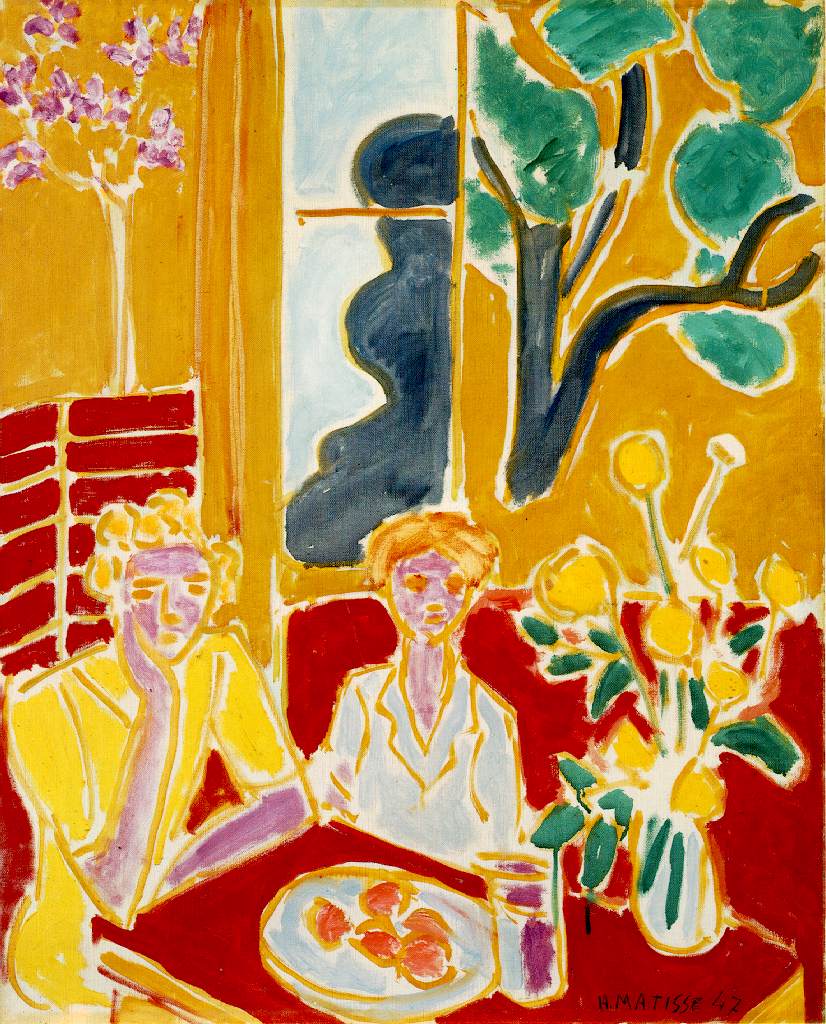
 Henri Matissse Deux fillettes, fond jaune et rouge (Two Girls in a Yellow and Red Interior) 1947 Barnes Foundation, Merion, PA
Londa Schlesinger’s “Nature’s Body” and Cynthia Russet Eagle’s “Sexual Science and the Construction of Victorian Womanhood” are two welcome books that show how both scientific ideas and race constructed a particular idea of womanhood in the nineteenth century. Most of the scientific ideas they analyze do not root on empirical data, but rather than on popular beliefs of what a woman should be. Those popular beliefs are part of popular science. The “scientification” of popular beliefs leads to a “naturalization” of gender. Londa Schiebinger makes an excellent use of the categories of gender and race to analyze a serious of scientific ideas of the nineteenth century. Schiebinger emphasis the importance of the joint study of gender and race because the scientific ideas she analysis aim to show the inferiority of women over men. Schiebinger asserts that the naturalization of gender imposes the construction of gender due to nature rather than to nurture as John Stuart Mill. Thus, women are inferior to men due to nature. John Stuart Mill’s idea of the construction of gender due to nurture gets lost. Eventually, Schiebinger argues that the construction of gender was based on biased “scientific observations’ that were rooted on the chauvinist idea of the inferiority women upon men. These popular beliefs are defined as social and popular beliefs of gender. Russet Eagle argues that a large number of scientific ideas of the Victorian era were based on popular beliefs of the idea of woman and men rather than on empirical data. She asserts that problem was that the “scientific’ “data that those scientists had was interpreted through the lenses of popular beliefs and prejudices. Moreover, Russet Eagle adds an interesting distinction depending on professions. She demonstrates that scientists were had a tendency to emphasize the inferiority of women and the importance of the private activities. Meanwhile, lawyers, writers, and others did not make such a strong distinction between men and women. What is more, the latter supported the suffragist movement of American and Great Britain. The nineteenth century’s scientists were obsessed in studying the differences between women and men in a large variety of both social and scientific disciplines. The bias of most of nineteenth century scientists was to take for granted their misogynistic arguments about gender differences. They transformed their popular beliefs into empirical data. Therefore, their construction of gender was rooted mostly on popular beliefs rather than on empirical data and observations. Through an examination of Darwinism, Darwinism, race, anatomy, physical anthropology, and physics it becomes clear that the construction of gender has been historically been influenced more by popular beliefs than by empirical data.
Darwin’s evolutionary theory demonstrated how in the evolution from apes to men, women were the link between the two. His evolutionary theory postulated the inferiority of men based on brain faculties, such as intelligence and smartness.
Department of History
Georgetown University


No comments:
Post a Comment