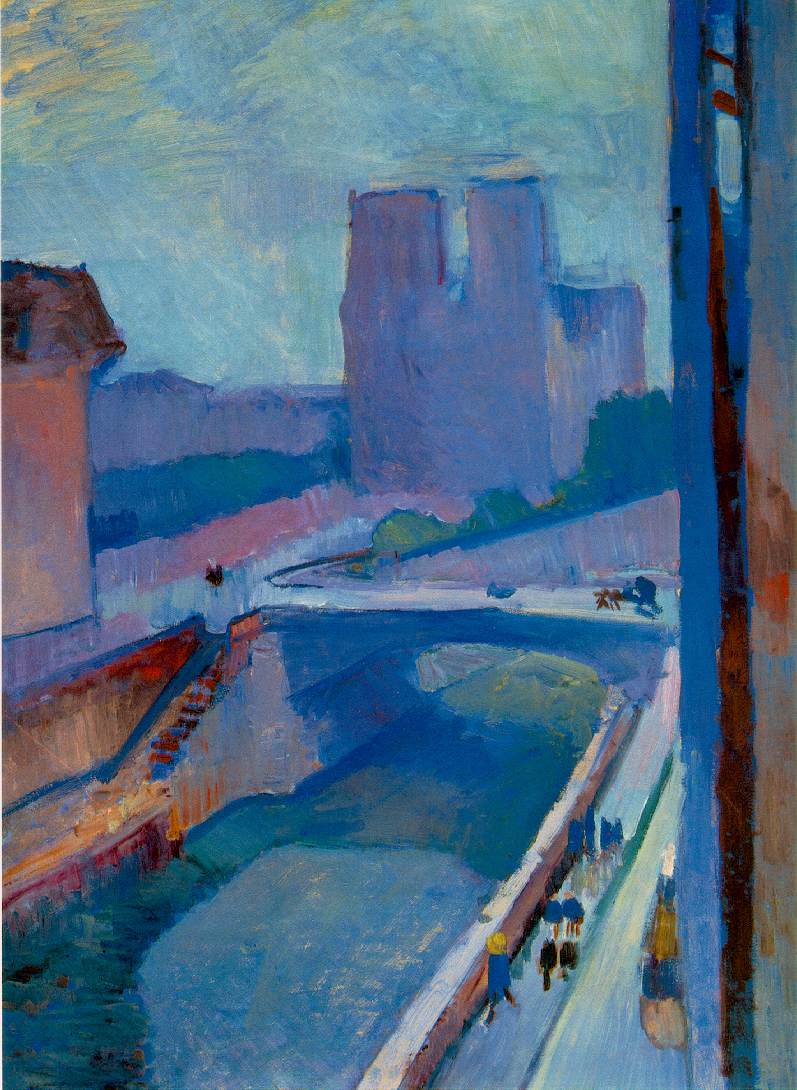
 Notre-Dame, une fin d'après-midi (A Glimpse of Notre Dame in the Late Afternoon) 1902 Albright-Knox Art Gallery, Buffalo, NY
1- Background
The main goal of this paper is to study the role of popular science in the construction of French nationhood after the 1870s. The aftermath of the Prussian-French War (1871-1872) led to a political and social vacuum in France. Neither loyalists nor republicans agreed on a political project and a possible body politic for France. The third and appealing alternative was the revival of Napoleon’s inheritance. The inability to reach a political and social consensus produced competing public spheres concerned with the definition of French national identity. As well as painters and novelists, science journalists were important social actors of the public sphere. Thus, a group of science journalists led by Gaston Tissandier became part of one of those public spheres arguing that science, politics, and technology were crucial factors in shaping France’s national identity and in encouraging a new public sphere.
A group of science writers blended ideas of science, social matters, and politics into a particular construction of nationhood. The appeal of science to a broad audience encouraged the understanding of nationhood throughout science articles and visual images. In the nineteenth century, the two main French science journals were Cosmos and La Nature. Science journals and science journalists were at their highest point in terms of readership and popularity in the second half of nineteenth century France. Gaston Tissandier, a ballonist and science amateur, started La Nature in 1873. He was the director and chef de redaction of La Nature from 1873 to 1899. La Nature coverage focused on popular science. La Nature’s science writers’ conveyed the idea of nationhood in a particular way. Eventually, those science writers had a peculiar goal in encouraging a particular public sphere that blended politics, popular science, and nationhood. The articles of the science writers of La Nature reflected a notion of nationhood that blended science with politics. Furthermore, the science writers concerns shows the constant and actual concern that France had in refining its national identity, particularly if one takes into account the Economic Union integration process. This paper seeks to unveil the particular idea of nationhood that a group of science writers conveyed to the French people from 1873 to 1914.
2- Review of the Literature
This research proposal focuses on the role of popular science on the construction of France’s national identity. Popular culture is a theoretical concept that illuminates the relationships between science, politics, and ‘nationhood. Along those lines, the fundamental issue is the proper conceptual approach to the study of popular culture. Thus, this section analyzes the historiographical changes of science in popular culture studies. Popular science is understood within the context of popular culture. There have been different approaches to the study of popular culture. Scholars such as Peter Burke introduced the importance of folklore in order to study the daily life of ordinary people. Burke’s main historical sources are songs, crafts, paintings, ballads, stories, and stories, among others. Peter Burke stresses the importance of studying popular culture as opposed to high culture. The former creates and leads to the flourishing of crafts and symbols of ordinary men, while the latter privileges the learned, the cultivated, repression of popular manifestations, and seeks to impose a worldview of culture. No matter how original and large in scope, Burke’s work is; Burke’s limitation is to deal with popular culture as if it were simply a collection of cultural products.
On the same lines, Roger Cooter and Steven Pumfrey encouraged the study of science in popular culture in order to understand the meaning of science for ordinary people, middle-classes, and minorities, such as women and marginal members of society. Science in popular culture was interested in cultural resistance, struggle, and appropriation. Nevertheless, their approach leaves aside the individual agency of ordinary people.
Paolo Rossi, Edgard Siszel, Stephen Pumfrey, Maurice Slawinki, and William Eamon attempt to understand science in popular culture by emphasizing the different roles that science played in the sixteenth century. Rossi, Pumfrey, Slawinki and Zilsel altered the understanding of the Scientific Revolution. For the first time in history, natural philosophers began to take notice of the activities of the artisan’s workshops, and the methodology of craftsmen provided a model for an entirely new experimental approach to the study of nature that culminated in the philosophy of Francis Bacon. They argued that there were changes in the institution, the role, and the social need of “scientists”.[1] Rossi and Zilsel demonstrated how the scientific activity shifted from universities to princely courts, formal urban academies, and organized scientific societies in the sixteenth century. Scientists became courtiers that had to meet the needs and whims of their patrons. These authors analyzed the source of authority in the sixteenth century and the arguments to legitimate scientific endeavors. The drawback of their approach is the scarcity of historical sources written by ordinary people.
William Eamon embraces Rossi and Zilsel’s argument of how craftsmen were active actors in the construction of scientific knowledge. Eamon argued that the relationship between natural philosophers and craftsmen led to the Baconian method. Eamon also argued that the scientific elite denied the craftsmen’s contribution to their new physical understanding of natural phenomena. The scientific elite did not want to make explicit that they were engaged in “pseudoscientific” activities and denied that they had appropriated craftsmen’s traditional knowledge. Eamon argued that both the empiricism and experience of the Baconian method have their origins in craftsmen’s traditional way of solving problems. The “Book of Secrets” illustrated how widespread empiricism and experience were among craftsmen. The “Book of Secrets” had nothing to do with magic, the supernatural, or occultism; on the contrary, it was the emergence of a new genre based on a set of “recipes” that told ordinary people how to solve everyday problems of the sixteenth century. The “Book of Secrets” was written by the urban intelligentsia of diverse social status. The intention of the authors was to acquire fame, and to advertise their recipes as a means of redefining their social status by using science and noble features. They did not confront the social or political organization of the sixteenth century. Therefore, their range of interests was limited, restricted to those arts, which did not come into conflict with aristocratic sensibilities. At the very end, the authors of the “Books of Secrets” did not want to overthrow the social, political, and economic structure of the sixteenth century. They merely sought to find their role within the urban learned elites of the Italian cities of the sixteenth century.
Steven Shapin and Simon Shaeffer analyze science as part of the public sphere by bringing the middle-classes into science studies. They study the ways in which audiences are constructed and transformed in changing historical contexts. Science is perceived as “science as culture”, strongly related to social values, perceptions, and attitudes. Shapin and Schaeffer focus on how educated classes use science because of its relationships with social values, status, and morality. Their works draw relationships between middle and upper-class values and scientific legitimization.
Bruno Latour introduces the anthropological approach to the study of science, studying behaviors and power-relationships of scientists within laboratories. Nevertheless, Latour’s approach is still elitist because the production of science belongs to learned and privileged elite. Moreover, Latour’s approach misses the relationship between science and middle-class men, ordinary people, or even people outside the laboratory.
There is also a historical trend that focuses on micro-histories. Micro-histories in science also pay attention to elites, such as Mario Biagioli’s study of Galileo as a courtier. Biagioli opens the game of science to the courts, the academies, and the universities. However, he extends science to women because they happen to be strong patrons. It is difficult for micro histories to focus entirely on popular behaviors.
Roger Chartier and Robert Darnton argue that popular culture is high culture. They contend that popular culture is the appropriation of popular writings, songs, and texts by the learned elite. Eventually, they deny the existence of popular culture in the absence of texts, codes, and written sources by ordinary people. They assert the importance of intermediaries of popular cultures. Furthermore, collective action and long-term ways of thinking are the means to understanding what ordinary people thought, perceived, and wrote. Chartier and Darnton conclude that the lack of written sources enable historians to understand the individual goals and thoughts of ordinary people. Nevertheless, they assert that reading few historical sources in an imaginative way, allow historians to grasp the collective ways of understanding the world of a society in a long-term period of time.
3- Original Contribution
Following the lines of Robert Darnton who analyzes popular science as a means to achieve social mobility, this proposal attempts to understand the role of popular science in the construction of French nationhood from 1873 to 1914. One chief goal is to study the interplay among politics, popular science, and nationhood. This research posits to understand the “published” idea of nationhood conveyed by La Nature. Moreover, it aims to find the relationships between science and nation. Benedict Anderson’s Imagined Communities are the starting point to this analysis of the ideas of nation and nationhood, particularly, his essays about print culture, mapping, and museums. How and why is science important to those science writers’ idea of nationhood? How does their idea of nationhood differ from those of others? The purpose of this research is to demonstrate the importance of popular science as an unavoidable means in creating and encouraging a particular idea of modern French nationhood.
4- Research Questions
My research questions, beginning from the general and moving to the specific are as follows: (1) how could popular culture encourage a specific idea of nationhood in which science, technology, and politics intertwine in the construction of a French national identity? (2) Are Benedict Anderson’s propositions about nationalism, print culture, mapping, and museums applicable to La Nature discourse? (3) Taking into account that those French science journalists were explicitly fostering a particular idea of nationhood, which are the debates and main issues that that public sphere perceived as important? (4) And finally, the essential proposition that I intend to test is that one of the many competing ideas of nationhood tied to science was a practical and rational approach to solving political and social differences at end of nineteenth century in France.
5- Primary Source Report
Textually, the focus of my research will be the nationhood narrative that appears in the science journal called La Nature. My criteria for preliminary selection were as follows: Identify a journal that popularized science, identify the publisher and science journalists of the journal; follow the scope of the publication and its commercial success. Such criteria will facilitate the analysis of an emerging new public sphere and nationhood identity.
Bibliography
- Ferguson, Niall, Germany and the Origins of the First World War: New Perspectives The historical Journal, vol. 35, issue 3, 1992, p 725-52.
Anderson, Benedict, Imagined communities: reflections on the origin and spread of nationalism (London: Verso, 1983) Bakhtin, M. M. (Mikhail Mikhailovich), The dialogic imagination (Austin: University of Texas Press, 1981) Bakhtin, M. M. (Mikhail Mikhailovich), Rabelais and his world (Bloomington, Ind. : Indiana University Press, 1984) Bigsby, C W, “The Politics of Popular Culture” , Cultures I, 1973: 15-37. Burke, Peter, Popular culture in early modern Europe (New York : Harper & Row, 1978, 1981)
Cooter, Roger, The cultural meaning of popular science : phrenology and the organization of consent in nineteenth-century Britain (Cambridge: New York: Cambridge University Press, 1984)
Cooter, Roger and Stephen Pumfrey “Separate Spheres and Public Places: Reflections on the History of Science Popularization and Science in Popular Culture”, History of Science 32, 1994) : 237-267.
Creager, Angela N.H., Elizabeth A. Lunbeck & Londa Schiebinger, Feminism in twentieth-century science, technology, and medicine (Chicago: University of Chicago Press, 2001)
Crossland, Maurice, Popular Science and the Arts: challenges to Cultural authority in France under the Second Empire, British Journal of History of Science, 2001.
Dansette, Adrien, Naissance de la France moderne : le Second Empire (Paris: Hachette, 1976)
Darnton Robert, The Brissot Dossier, French Historical Studies, Vol. 17, No. 1. (Spring, 1991), pp. 191-205.
Darnton, Robert, Sounding the Literary Marketing Prerevolutionary France, Eighteenth-Century Studies, Vol. 17, No. 4, Special Issue: The Printed Word in the Eighteenth Century. (Summer, 1984), pp. 477-492.
Darnton, Robert, The Business of Enlightenment: A Publishing History of the Encyclopedie, 1775-1800, History of Education Quarterly, Vol. 22, No. 1. (Spring, 1982), pp. 89-98.
Darnton, Robert, The Grub Street Stule of Revolution of Revolution: J. P. Brissot, Police Spy, The Journal of Modern History, Vol. 40, No. 3. (Sep., 1968), pp. 301-327.
Darnton, Robert, Mesmerism and the end of the Enlightenment in France (Cambridge, Mass., Harvard University Press, 1968)
Doving, Karin, "Communication, Dissenters, nad Popular Culture in Eighteenth Century Europe" Journal of Popular Culture 7 (1973): 559-568
Eagle Russett, Cynthia, Sexual Science. The Victorian Construction of Womanhood (Cambridge, Harvard University Press, 1989) Eamon, William, Science and Popular Culture in the Sixteenth Century Italy: The “Professors of Secrets” and their Books, Sixteenth Century Journal, Vol. 16, No. 4. (Winter, 1985), pp. 471-485.
Francis, Demuer, La France du XIXe siecle : 1814-1914 (Paris : Editions du Seuil, 2000)
Furet, Francois, Revolutionary France : 1788-1880 (Oxford ; New York: Oxford University Press, 2002)
Golinski, Jan, Science as Public Culture : Chemistry and Enlightenment in Britain, 1760-1820 (Cambridge ; New York : Cambridge University Press, 1992)
Golinski, Jan, Science as public culture : chemistry and enlightenment in Britain, 1760- 1820 (Cambridge ; New York : Cambridge University Press, 1992)
Habermas, Jürgen, The structural transformation of the public sphere : an inquiry into a category of bourgeois society (Cambridge, Mass. : MIT Press, 1989)
Layton, David, Diction and Dictionaries in the Diffusio of Scientific Knowledge: An . Aspect of History of the Popularization of Science in Great Britain, British Journal for th eHistory of Science 2, 1965, : 221-234.
Lightman, Bernard, The Visual Theology of Victorian Popularizers of Science. From Reverent Eye to Chemical Retina, Isis, Vol. 91, No. 4. (Dec., 2000), pp. 651-680
Lynn K. Nyhart and Thomas Broman, Science and Civil Society, Osiris, 2002.
Lynn, Michael R., Divining the Enlightenment: Public Opinion and Popular Science in the Old Regime France, Isis, Vol. 92, No. 1. (Mar., 2001), pp. 34-54.
Lynn, Michael R., Enlightenment in the Public Sphere: The Musee de Monsieur and_Scientific Culture in Late-Eighteenth-Century Paris, in Eighteenth-Century Studies, Vol. 32, No. 4, Sites and Margins of the Public Sphere. (Summer, 1999), pp. 463-476.
Macolmson, Robert, Popular Culture and Social Change “Journal of Popular Culture 4, 1971): 1039-1044.
Martinez, Eduardo, Flores, Jorge, La popularización de la ciencia y la tecnología: reflexiones básicas, (México: Fondo de Cultura Económica, 1997)
Mullet, Michael, Popular Culture and Popular Protest in Late Medieval and Early Modern Europe (NY: Croom Helm, 1987)
Pumfrey, Stephen, Paolo L. Rossi, and Maurice Slawinski, Science, culture, and popular belief in Renaissance Europe, (Manchester ; New York : Manchester University Press, 1991) Rossi, Paolo, The birth of modern science (Oxford, UK: Blackwell Publishers, 2001)
Schaffer, Simon, Natural Philosophy and Public Spectacle in the Eighteenth Century”, History of Science, 21, 1983): 1-43
Schiebinger, Londa, The mind has no sex? : women in the origins of modern science, (Cambridge, Mass. : Harvard University Press, 1989)
Schiebinger, Londa, Nature's body: gender in the making of modern science, (Boston : Beacon Press, 1993)
Schnechner, Sara, Comets, Popular Culture, and the Birth of Modern Cosmology (Princeton: Princeton University Press, 1997)
Shteir, Ann B. Gender and “Modern” Botany in Victorian England, Osiris, 2nd Series, Vol. 12, Women, Gender, and Science: New Directions. (1997), pp. 29-38.
Shteir, Ann B. Botanical Dialogues: Maria Jacson and Women’s Popular Science Writing in England, Eighteenth-Century Studies, Vol. 23, No. 3. (Spring, 1990), pp. 301-317.
Secord, James A., Nature’s Fancy: Charles Darwin and the Breeding of Pigeons. Isis, Vol. 72, No. 2. (Jun., 1981), pp. 162-186.
Seidman, Steven Jürgen Habermas on society and politics : a reader (Boston: Beacon Press, 1989)
Tombs, Robert, France, 1814-1914 (London: New York : Longman, 1996)
Topham, Jonathan R., “Beyond the “Common Context”: The Production and Reading of the Bridgewater Treatises. Isis, Vol. 89, No. 2. (Jun., 1998), pp. 233-262.
Stuart S. Blume, Perspectives in the sociology of science (Chichester: New York : Wiley, 1977)
[1] The use of scientist for the eighteenth is an anachronysm that Rossi and Silzel should pay attention to by redefining his concept of scientist.
The main goal of this paper is to study the role of popular science in the construction of French nationhood after the 1870s. The aftermath of the Prussian-French War (1871-1872) led to a political and social vacuum in France. Neither loyalists nor republicans agreed on a political project and a possible body politic for France. The third and appealing alternative was the revival of Napoleon’s inheritance. The inability to reach a political and social consensus produced competing public spheres concerned with the definition of French national identity. As well as painters and novelists, science journalists were important social actors of the public sphere. Thus, a group of science journalists led by Gaston Tissandier became part of one of those public spheres arguing that science, politics, and technology were crucial factors in shaping France’s national identity and in encouraging a new public sphere.
A group of science writers blended ideas of science, social matters, and politics into a particular construction of nationhood. The appeal of science to a broad audience encouraged the understanding of nationhood throughout science articles and visual images. In the nineteenth century, the two main French science journals were Cosmos and La Nature. Science journals and science journalists were at their highest point in terms of readership and popularity in the second half of nineteenth century France. Gaston Tissandier, a ballonist and science amateur, started La Nature in 1873. He was the director and chef de redaction of La Nature from 1873 to 1899. La Nature coverage focused on popular science. La Nature’s science writers’ conveyed the idea of nationhood in a particular way. Eventually, those science writers had a peculiar goal in encouraging a particular public sphere that blended politics, popular science, and nationhood. The articles of the science writers of La Nature reflected a notion of nationhood that blended science with politics. Furthermore, the science writers concerns shows the constant and actual concern that France had in refining its national identity, particularly if one takes into account the Economic Union integration process. This paper seeks to unveil the particular idea of nationhood that a group of science writers conveyed to the French people from 1873 to 1914.
2- Review of the Literature
This research proposal focuses on the role of popular science on the construction of France’s national identity. Popular culture is a theoretical concept that illuminates the relationships between science, politics, and ‘nationhood. Along those lines, the fundamental issue is the proper conceptual approach to the study of popular culture. Thus, this section analyzes the historiographical changes of science in popular culture studies. Popular science is understood within the context of popular culture. There have been different approaches to the study of popular culture. Scholars such as Peter Burke introduced the importance of folklore in order to study the daily life of ordinary people. Burke’s main historical sources are songs, crafts, paintings, ballads, stories, and stories, among others. Peter Burke stresses the importance of studying popular culture as opposed to high culture. The former creates and leads to the flourishing of crafts and symbols of ordinary men, while the latter privileges the learned, the cultivated, repression of popular manifestations, and seeks to impose a worldview of culture. No matter how original and large in scope, Burke’s work is; Burke’s limitation is to deal with popular culture as if it were simply a collection of cultural products.
On the same lines, Roger Cooter and Steven Pumfrey encouraged the study of science in popular culture in order to understand the meaning of science for ordinary people, middle-classes, and minorities, such as women and marginal members of society. Science in popular culture was interested in cultural resistance, struggle, and appropriation. Nevertheless, their approach leaves aside the individual agency of ordinary people.
Paolo Rossi, Edgard Siszel, Stephen Pumfrey, Maurice Slawinki, and William Eamon attempt to understand science in popular culture by emphasizing the different roles that science played in the sixteenth century. Rossi, Pumfrey, Slawinki and Zilsel altered the understanding of the Scientific Revolution. For the first time in history, natural philosophers began to take notice of the activities of the artisan’s workshops, and the methodology of craftsmen provided a model for an entirely new experimental approach to the study of nature that culminated in the philosophy of Francis Bacon. They argued that there were changes in the institution, the role, and the social need of “scientists”.[1] Rossi and Zilsel demonstrated how the scientific activity shifted from universities to princely courts, formal urban academies, and organized scientific societies in the sixteenth century. Scientists became courtiers that had to meet the needs and whims of their patrons. These authors analyzed the source of authority in the sixteenth century and the arguments to legitimate scientific endeavors. The drawback of their approach is the scarcity of historical sources written by ordinary people.
William Eamon embraces Rossi and Zilsel’s argument of how craftsmen were active actors in the construction of scientific knowledge. Eamon argued that the relationship between natural philosophers and craftsmen led to the Baconian method. Eamon also argued that the scientific elite denied the craftsmen’s contribution to their new physical understanding of natural phenomena. The scientific elite did not want to make explicit that they were engaged in “pseudoscientific” activities and denied that they had appropriated craftsmen’s traditional knowledge. Eamon argued that both the empiricism and experience of the Baconian method have their origins in craftsmen’s traditional way of solving problems. The “Book of Secrets” illustrated how widespread empiricism and experience were among craftsmen. The “Book of Secrets” had nothing to do with magic, the supernatural, or occultism; on the contrary, it was the emergence of a new genre based on a set of “recipes” that told ordinary people how to solve everyday problems of the sixteenth century. The “Book of Secrets” was written by the urban intelligentsia of diverse social status. The intention of the authors was to acquire fame, and to advertise their recipes as a means of redefining their social status by using science and noble features. They did not confront the social or political organization of the sixteenth century. Therefore, their range of interests was limited, restricted to those arts, which did not come into conflict with aristocratic sensibilities. At the very end, the authors of the “Books of Secrets” did not want to overthrow the social, political, and economic structure of the sixteenth century. They merely sought to find their role within the urban learned elites of the Italian cities of the sixteenth century.
Steven Shapin and Simon Shaeffer analyze science as part of the public sphere by bringing the middle-classes into science studies. They study the ways in which audiences are constructed and transformed in changing historical contexts. Science is perceived as “science as culture”, strongly related to social values, perceptions, and attitudes. Shapin and Schaeffer focus on how educated classes use science because of its relationships with social values, status, and morality. Their works draw relationships between middle and upper-class values and scientific legitimization.
Bruno Latour introduces the anthropological approach to the study of science, studying behaviors and power-relationships of scientists within laboratories. Nevertheless, Latour’s approach is still elitist because the production of science belongs to learned and privileged elite. Moreover, Latour’s approach misses the relationship between science and middle-class men, ordinary people, or even people outside the laboratory.
There is also a historical trend that focuses on micro-histories. Micro-histories in science also pay attention to elites, such as Mario Biagioli’s study of Galileo as a courtier. Biagioli opens the game of science to the courts, the academies, and the universities. However, he extends science to women because they happen to be strong patrons. It is difficult for micro histories to focus entirely on popular behaviors.
Roger Chartier and Robert Darnton argue that popular culture is high culture. They contend that popular culture is the appropriation of popular writings, songs, and texts by the learned elite. Eventually, they deny the existence of popular culture in the absence of texts, codes, and written sources by ordinary people. They assert the importance of intermediaries of popular cultures. Furthermore, collective action and long-term ways of thinking are the means to understanding what ordinary people thought, perceived, and wrote. Chartier and Darnton conclude that the lack of written sources enable historians to understand the individual goals and thoughts of ordinary people. Nevertheless, they assert that reading few historical sources in an imaginative way, allow historians to grasp the collective ways of understanding the world of a society in a long-term period of time.
3- Original Contribution
Following the lines of Robert Darnton who analyzes popular science as a means to achieve social mobility, this proposal attempts to understand the role of popular science in the construction of French nationhood from 1873 to 1914. One chief goal is to study the interplay among politics, popular science, and nationhood. This research posits to understand the “published” idea of nationhood conveyed by La Nature. Moreover, it aims to find the relationships between science and nation. Benedict Anderson’s Imagined Communities are the starting point to this analysis of the ideas of nation and nationhood, particularly, his essays about print culture, mapping, and museums. How and why is science important to those science writers’ idea of nationhood? How does their idea of nationhood differ from those of others? The purpose of this research is to demonstrate the importance of popular science as an unavoidable means in creating and encouraging a particular idea of modern French nationhood.
4- Research Questions
My research questions, beginning from the general and moving to the specific are as follows: (1) how could popular culture encourage a specific idea of nationhood in which science, technology, and politics intertwine in the construction of a French national identity? (2) Are Benedict Anderson’s propositions about nationalism, print culture, mapping, and museums applicable to La Nature discourse? (3) Taking into account that those French science journalists were explicitly fostering a particular idea of nationhood, which are the debates and main issues that that public sphere perceived as important? (4) And finally, the essential proposition that I intend to test is that one of the many competing ideas of nationhood tied to science was a practical and rational approach to solving political and social differences at end of nineteenth century in France.
5- Primary Source Report
Textually, the focus of my research will be the nationhood narrative that appears in the science journal called La Nature. My criteria for preliminary selection were as follows: Identify a journal that popularized science, identify the publisher and science journalists of the journal; follow the scope of the publication and its commercial success. Such criteria will facilitate the analysis of an emerging new public sphere and nationhood identity.
Bibliography
- Ferguson, Niall, Germany and the Origins of the First World War: New Perspectives The historical Journal, vol. 35, issue 3, 1992, p 725-52.
Anderson, Benedict, Imagined communities: reflections on the origin and spread of nationalism (London: Verso, 1983) Bakhtin, M. M. (Mikhail Mikhailovich), The dialogic imagination (Austin: University of Texas Press, 1981) Bakhtin, M. M. (Mikhail Mikhailovich), Rabelais and his world (Bloomington, Ind. : Indiana University Press, 1984) Bigsby, C W, “The Politics of Popular Culture” , Cultures I, 1973: 15-37. Burke, Peter, Popular culture in early modern Europe (New York : Harper & Row, 1978, 1981)
Cooter, Roger, The cultural meaning of popular science : phrenology and the organization of consent in nineteenth-century Britain (Cambridge: New York: Cambridge University Press, 1984)
Cooter, Roger and Stephen Pumfrey “Separate Spheres and Public Places: Reflections on the History of Science Popularization and Science in Popular Culture”, History of Science 32, 1994) : 237-267.
Creager, Angela N.H., Elizabeth A. Lunbeck & Londa Schiebinger, Feminism in twentieth-century science, technology, and medicine (Chicago: University of Chicago Press, 2001)
Crossland, Maurice, Popular Science and the Arts: challenges to Cultural authority in France under the Second Empire, British Journal of History of Science, 2001.
Dansette, Adrien, Naissance de la France moderne : le Second Empire (Paris: Hachette, 1976)
Darnton Robert, The Brissot Dossier, French Historical Studies, Vol. 17, No. 1. (Spring, 1991), pp. 191-205.
Darnton, Robert, Sounding the Literary Marketing Prerevolutionary France, Eighteenth-Century Studies, Vol. 17, No. 4, Special Issue: The Printed Word in the Eighteenth Century. (Summer, 1984), pp. 477-492.
Darnton, Robert, The Business of Enlightenment: A Publishing History of the Encyclopedie, 1775-1800, History of Education Quarterly, Vol. 22, No. 1. (Spring, 1982), pp. 89-98.
Darnton, Robert, The Grub Street Stule of Revolution of Revolution: J. P. Brissot, Police Spy, The Journal of Modern History, Vol. 40, No. 3. (Sep., 1968), pp. 301-327.
Darnton, Robert, Mesmerism and the end of the Enlightenment in France (Cambridge, Mass., Harvard University Press, 1968)
Doving, Karin, "Communication, Dissenters, nad Popular Culture in Eighteenth Century Europe" Journal of Popular Culture 7 (1973): 559-568
Eagle Russett, Cynthia, Sexual Science. The Victorian Construction of Womanhood (Cambridge, Harvard University Press, 1989) Eamon, William, Science and Popular Culture in the Sixteenth Century Italy: The “Professors of Secrets” and their Books, Sixteenth Century Journal, Vol. 16, No. 4. (Winter, 1985), pp. 471-485.
Francis, Demuer, La France du XIXe siecle : 1814-1914 (Paris : Editions du Seuil, 2000)
Furet, Francois, Revolutionary France : 1788-1880 (Oxford ; New York: Oxford University Press, 2002)
Golinski, Jan, Science as Public Culture : Chemistry and Enlightenment in Britain, 1760-1820 (Cambridge ; New York : Cambridge University Press, 1992)
Golinski, Jan, Science as public culture : chemistry and enlightenment in Britain, 1760- 1820 (Cambridge ; New York : Cambridge University Press, 1992)
Habermas, Jürgen, The structural transformation of the public sphere : an inquiry into a category of bourgeois society (Cambridge, Mass. : MIT Press, 1989)
Layton, David, Diction and Dictionaries in the Diffusio of Scientific Knowledge: An . Aspect of History of the Popularization of Science in Great Britain, British Journal for th eHistory of Science 2, 1965, : 221-234.
Lightman, Bernard, The Visual Theology of Victorian Popularizers of Science. From Reverent Eye to Chemical Retina, Isis, Vol. 91, No. 4. (Dec., 2000), pp. 651-680
Lynn K. Nyhart and Thomas Broman, Science and Civil Society, Osiris, 2002.
Lynn, Michael R., Divining the Enlightenment: Public Opinion and Popular Science in the Old Regime France, Isis, Vol. 92, No. 1. (Mar., 2001), pp. 34-54.
Lynn, Michael R., Enlightenment in the Public Sphere: The Musee de Monsieur and_Scientific Culture in Late-Eighteenth-Century Paris, in Eighteenth-Century Studies, Vol. 32, No. 4, Sites and Margins of the Public Sphere. (Summer, 1999), pp. 463-476.
Macolmson, Robert, Popular Culture and Social Change “Journal of Popular Culture 4, 1971): 1039-1044.
Martinez, Eduardo, Flores, Jorge, La popularización de la ciencia y la tecnología: reflexiones básicas, (México: Fondo de Cultura Económica, 1997)
Mullet, Michael, Popular Culture and Popular Protest in Late Medieval and Early Modern Europe (NY: Croom Helm, 1987)
Pumfrey, Stephen, Paolo L. Rossi, and Maurice Slawinski, Science, culture, and popular belief in Renaissance Europe, (Manchester ; New York : Manchester University Press, 1991) Rossi, Paolo, The birth of modern science (Oxford, UK: Blackwell Publishers, 2001)
Schaffer, Simon, Natural Philosophy and Public Spectacle in the Eighteenth Century”, History of Science, 21, 1983): 1-43
Schiebinger, Londa, The mind has no sex? : women in the origins of modern science, (Cambridge, Mass. : Harvard University Press, 1989)
Schiebinger, Londa, Nature's body: gender in the making of modern science, (Boston : Beacon Press, 1993)
Schnechner, Sara, Comets, Popular Culture, and the Birth of Modern Cosmology (Princeton: Princeton University Press, 1997)
Shteir, Ann B. Gender and “Modern” Botany in Victorian England, Osiris, 2nd Series, Vol. 12, Women, Gender, and Science: New Directions. (1997), pp. 29-38.
Shteir, Ann B. Botanical Dialogues: Maria Jacson and Women’s Popular Science Writing in England, Eighteenth-Century Studies, Vol. 23, No. 3. (Spring, 1990), pp. 301-317.
Secord, James A., Nature’s Fancy: Charles Darwin and the Breeding of Pigeons. Isis, Vol. 72, No. 2. (Jun., 1981), pp. 162-186.
Seidman, Steven Jürgen Habermas on society and politics : a reader (Boston: Beacon Press, 1989)
Tombs, Robert, France, 1814-1914 (London: New York : Longman, 1996)
Topham, Jonathan R., “Beyond the “Common Context”: The Production and Reading of the Bridgewater Treatises. Isis, Vol. 89, No. 2. (Jun., 1998), pp. 233-262.
Stuart S. Blume, Perspectives in the sociology of science (Chichester: New York : Wiley, 1977)
[1] The use of scientist for the eighteenth is an anachronysm that Rossi and Silzel should pay attention to by redefining his concept of scientist.


I wrote this in my Georgetown University course. At least you can enjoy the pictures.
ReplyDelete